
See how click-through rate, cost per click, conversion rate, and cost per lead changed from 2025 to 2026, with industry data to help you evaluate paid-search performance.\
Updated: June 2026
- Before You Compare Your Industry's Paid Search Numbers
- What Has Changed in Google Ads for 2026?
- Core Metrics for Analyzing Your Paid Search Results
- Google Ads Benchmark Data for 2026 vs Previous Years
- Key Takeaways: 2025 vs 2026 Paid Ad Performance
- What to Review Before You Change Your 2026 Budget
- Review Your Google Ads Data Before You Spend More
2026 Google Ads Performance Trends Across Industries
If you’re responsible for a Google Ads budget, you have probably asked some version of the same question: are we paying for real opportunities, or just paying for clicks? A campaign can bring in calls, quote requests, online orders, and booked appointments, but the numbers only mean something when they are tied to qualified leads and revenue.
The 2026 benchmarks below give business owners and digital marketing teams a reference point for click-through rate (CTR), cost-per-click (CPC), conversion rate (CVR), and cost per lead (CPL). Start there, then compare the data against your own sales process, margins, service area, and the kinds of customers your business wants to attract.
Before You Compare Your Industry’s Paid Search Numbers
These figures come from WordStream and LocaliQ’s 2026 report, which reviewed 13,474 U.S. search campaigns across 23 industries between April 2025 and March 2026. Medium figures from Google Ads and Microsoft Ads data are used to limit the impact of unusually high or low results. Use the data as a reference point, not a fixed rate for your business. A Raleigh personal injury firm, for example, competes differently from a family-law practice, even though both fall under legal services.
Benchmark your advertising performance against 2026 industry averages, but keep the factors that shape your own results in view, including:
- The locations where you actually sell or provide service
- Branded versus non-branded search terms
- Your campaign goals, bidding settings, and daily budget
- What is counted as a conversion, such as a call, form, purchase, or appointment
- How quickly your team responds to leads and how many become customers
A $60 lead that turns into a profitable sale can be better than a $25 lead that never answers the phone. The opposite can be true as well. In a B2B Google Ad campaign, a higher CPL may be reasonable when one qualified opportunity can turn into a long-term account.
What Has Changed in Google Ads for 2026?
More Automation, With More Settings to Watch
Automation can make more decisions inside Google Ads, but it should not be left unchecked. AI Max for Search may show your ads for a wider range of searches, adjust ad wording, and send visitors to different pages on your website.
Before using it, make sure Google can only send people to pages that fit your services, your business details are accurate, and the system is being told which actions count as a real lead, such as a qualified phone call or completed appointment request.
Common tools used in 2026 include:
- AI Max for Search: Adds broader matching, text customization, and Final URL expansion.
- Smart Bidding: Adjusts bids toward your conversion or conversion-value goal.
- Performance Max: Uses assets, audience signals, conversion goals, and product data across Google inventory.
- Dynamic Search Ads: Finds opportunities from site content but needs clean page structure and regular search-term review.
Use Real Customer Information, Not Broad Assumptions
Google Ads can use information from people who have already interacted with your business, such as past customers or visitors to a specific service page. This can give automated campaigns a better starting point than broad interest categories alone.
For example, a business might show follow-up ads to people who requested an estimate or use a current customer list to help Google identify similar prospects. The lists need to be accurate, up to date, and used appropriately. A broad audience list will not make up for an unclear offer or a landing page that does not answer the visitor’s question.
AI Search, GEO, and Paid Search Visibility
People are using AI Overviews and AI Mode to ask broader questions, compare options, and narrow down choices before clicking on a website that comes up in their search results. That can change which searches bring visitors to your site and make it harder to judge paid search by clicks alone.
Some ads from eligible Performance Max, Shopping, and Search campaigns may appear in these AI-powered results when they fit the search. Do not build your budget around that possibility. Keep your website information accurate, make your offer easy to understand, and track the actions that lead to real inquiries or sales.
You may hear the website side of this called Generative Engine Optimization (GEO). Think of it as an extension of SEO, not a separate fix. Your website’s pages still need to answer customer questions and clearly explain your services, locations, policies, and experience.
Video and Visual Campaigns Play a Different Role
Search ads reach people already looking for a product or service. Video and visual ads can introduce your business earlier, helping build awareness and bring past visitors back when they are ready to act.
Demand Gen runs across YouTube, Shorts, Discover, Gmail, and Display. Performance Max uses text, images, video, and product data across Google. Review these campaigns based on audience reach, return visits, leads, and sales over time.
Reporting Is Only as Useful as the Conversion Setup
Google Ads now offers more reporting around assets, channels, search terms, audiences, and landing pages, especially in AI-supported campaigns. The reporting gets more useful when the account distinguishes between a real sales opportunity and a low-value action.
For a lead-generation business, that could mean tracking a phone call longer than a set duration, a completed estimate request, a booked appointment, a qualified CRM lead, and closed revenue as separate outcomes. Google Analytics 4 (GA4), call tracking, Google Ads conversion tracking, and CRM data should tell the same story. A completed form by itself does not prove a campaign is profitable.
Local Targeting Has Moved Beyond Old Local Campaigns
Local campaigns are no longer the main option for reaching nearby customers. Businesses can now use Search, Performance Max, location assets, and Google Maps placements to drive calls, directions, store visits, and other local actions.
It’s important to remember that covering more territory does not always mean you will receive better leads. Focus your ads on areas your team can reach quickly and serve well, then review which locations produce calls and estimates that become customers before expanding.
E-Commerce Still Depends on Accurate Product Information
Before running more ads, make sure the product details shoppers see are correct. Your prices, stock status, shipping information, product photos, sizes or colors, and product-page links all come from your Google Merchant Center feed. Errors can keep products from showing or send shoppers to a page that does not match the ad.
Smart Shopping is no longer a separate campaign type. Retailers now use tools such as Shopping ads and Performance Max to promote products across Google. Do not judge results by low click costs alone. The better question is whether ads are bringing in profitable sales after product costs, returns, shipping, and ad spend.
Core Metrics for Analyzing Your Paid Search Results
Measuring success with Google Ads is essential for understanding how well your campaigns are performing while identifying areas for optimization. By tracking KPIs, businesses can make better-informed decisions to improve their ad strategies.
Each of these benchmarks provides valuable insights into the effectiveness of targeting, ad creatives, and bidding strategies.
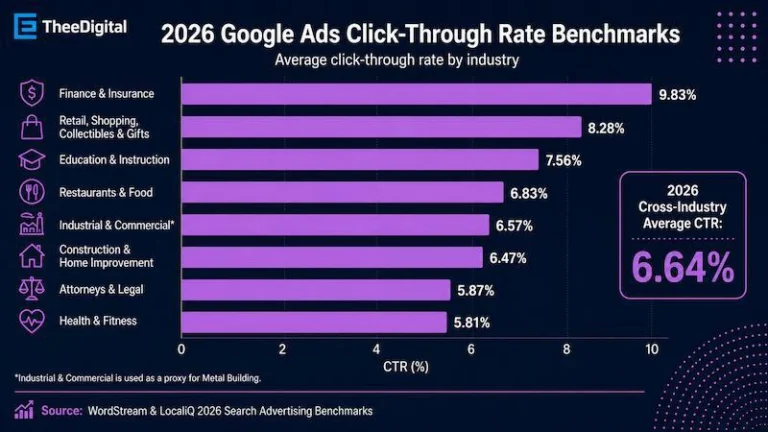
Click-Through Rate (CTR)
CTR is the percentage of people who click after seeing your ad. It can show whether the search, ad message, and offer are lining up well enough to get attention. A low CTR may point to weak ad copy, broad keywords, or an offer that does not match what people are searching for. A high CTR is not always a win, even if the ad attracts people who are unlikely to become customers.
The 2026 cross-industry benchmark is 6.64%.
Cost Per Click (CPC)
CPC is the average amount you pay each time someone clicks your ad. Costs can change based on the keyword, location, competition, device, bidding settings, and how valuable a new customer is likely to be. Legal and home improvement searches often cost more than restaurant or travel searches. A higher CPC is not automatically a problem if those clicks lead to qualified customers.
The 2026 cross-industry benchmark is $5.42.

Cost Per Lead (CPL)
CPL is the average amount spent to generate a tracked lead or conversion. Before comparing your number with an industry benchmark, make sure your business is counting the right actions.
A missed call, an incomplete form, a booked consultation, and a completed purchase do not carry the same value. A low CPL may look good in a report while still sending the sales team unqualified inquiries.
The 2026 cross-industry benchmark is $66.69.

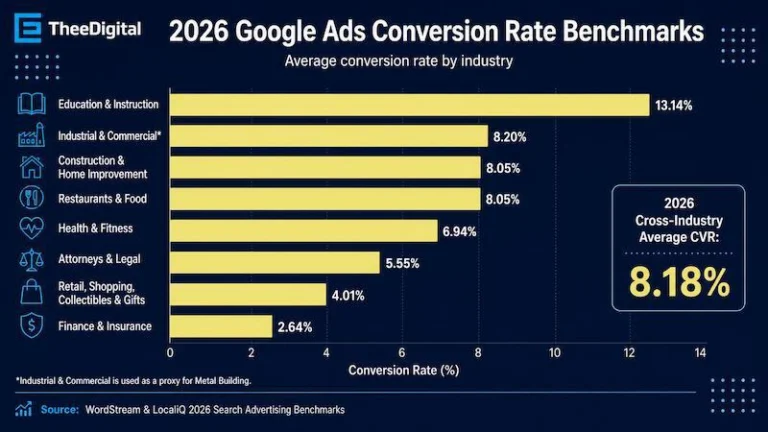
Conversion Rate (CVR)
CVR shows the percentage of ad clicks that lead to a tracked action, such as a phone call, form submission, appointment request, or purchase. It gives you a sense of whether the ad, landing page, and offer are working together. A higher CVR can reflect a better page or stronger offer, but it can also rise when an account starts tracking easier actions. Check who is converting and what happens after they do.
The 2026 cross-industry benchmark is 8.18%.
Return on Investment (ROI)
ROI of PPC campaigns compares what a campaign brings in with what it costs to run. A campaign may generate inexpensive clicks or leads and still fall short if those leads do not turn into sales. There is no single ROI benchmark that applies to every business. Revenue, profit margin, close rate, sales cycle, repeat purchases, and customer lifetime value all affect the result.
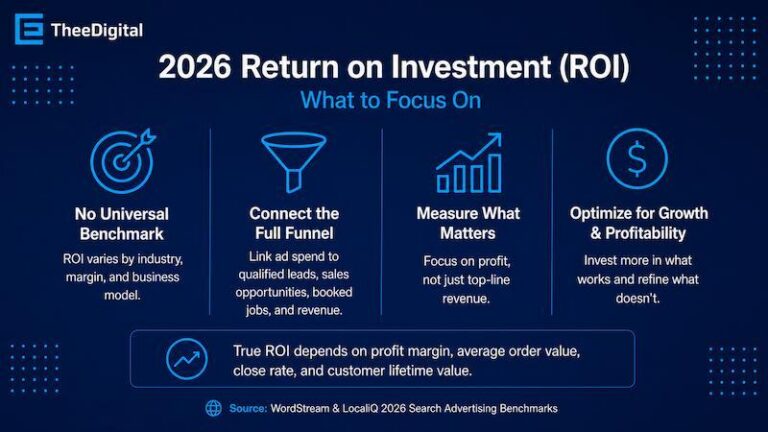
To evaluate ROI, connect Google Ads activity to qualified leads, sales opportunities, booked jobs, and revenue.
Want your actual number instead of an industry average?
The benchmarks above show what similar businesses are seeing, but your real ROI depends on your close rate, margins, and customer value. Plug in your own numbers with our Google Ads ROI Calculator to see where your campaigns actually stand.
Google Ads Benchmark Data for 2026 vs Previous Years’
Understanding the projected changes in key metrics for a variety of business types helps business owners optimize their own ad campaigns. Let’s look at the performance benchmarks for several key industries that thrive from utilizing digital marketing strategies through Google Ads.
Attorneys and Legal Services
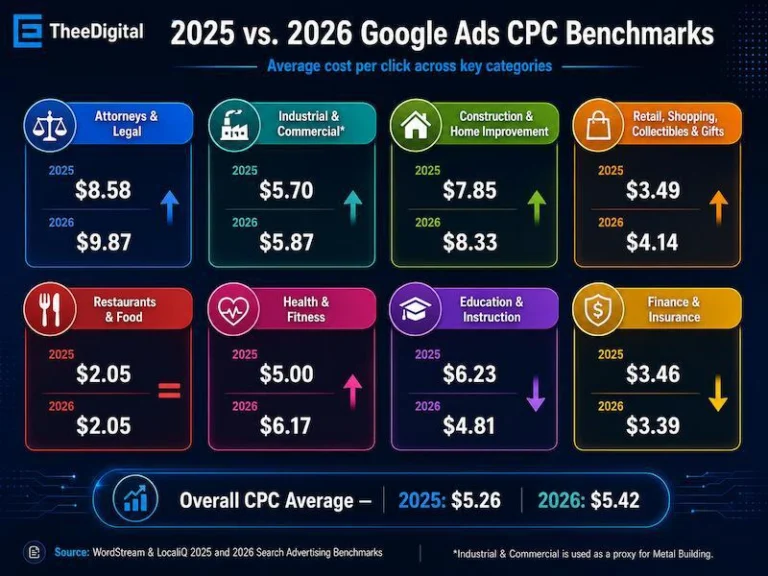
Legal was still the most expensive category in the 2026 data for both CPC and CPL. A firm should not judge success by lead volume alone. Practice area, signed-case value, intake speed, and conflict screening can change the value of a lead quickly.
Click-Through Rate
Legal CTR slipped by 0.10 percentage points from 2025 to 2026. It is a small move, but it is worth checking whether ads are still matching the client’s specific problem, location, and type of legal help.
- 2024: 5.30%
- 2025: 5.97%
- 2026: 5.87%
Cost Per Click
CPC for legal services jumped $1.29 year over year. Before paying more for broad terms, look at your company’s search query report and separate high-value practice areas from generic research searches that rarely produce viable cases.
- 2024: $8.94
- 2025: $8.58
- 2026: $9.87
Cost Per Lead
CPL held steady at $131.63. That consistent number is not a reason to relax your intake standards. The account still needs to separate qualified consultations from people who are outside the firm’s jurisdiction, case type, or budget.
- 2024: $144.03
- 2025: $131.63
- 2026: $131.63
Conversion Rate
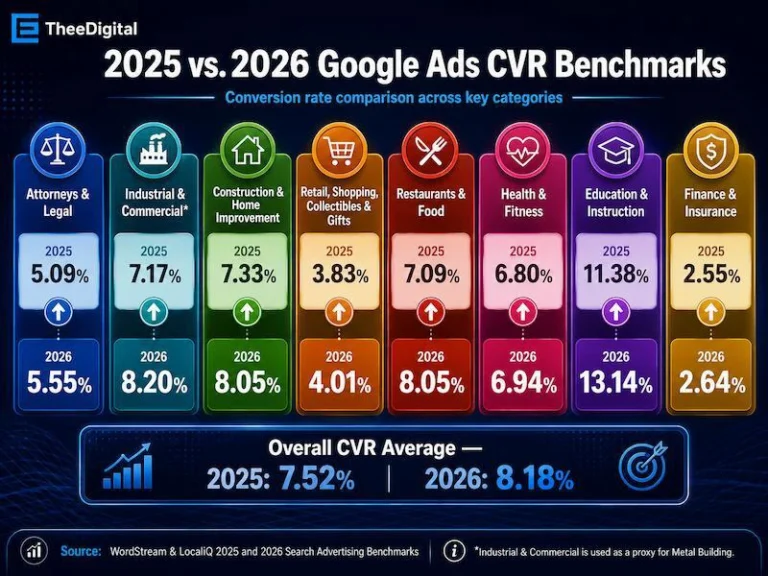
CVR improved from 5.09% to 5.55%. More clicks became tracked actions, but a law firm should verify that those actions are calls and inquiries worth following up on rather than low-intent form submissions.
- 2024: 5.64%
- 2025: 5.09%
- 2026: 5.55%
Industrial and Commercial Metal Building Industry
WordStream and LocaliQ do not publish a separate Metal Building category. The numbers below use their data from industrial and commercial service providers, which is a broader group that includes manufacturers, suppliers, and other commercial businesses. Use it as a directional reference, then compare it with your own building types, regions, project sizes, and sales cycle.
Click-Through Rate
Industrial and commercial CTR rose from 6.23% to 6.57%. That is a good reason to check which queries are driving engagement: warehouse buildings, agricultural structures, storage buildings, and commercial systems do not all attract the same buyer.
- 2024: 5.83%
- 2025: 6.23%
- 2026: 6.57%
Cost Per Click
CPC edged up by $0.17. The increase is modest, but high-ticket searches should be kept separate from early research terms so sales teams are not spending time on people who are only collecting general information.
- 2024: $4.95
- 2025: $5.70
- 2026: $5.87
Cost Per Lead
CPL dropped by more than $10 from 2025 to 2026. That gives metal building companies more room to test new ads or keywords, but it does not mean every inquiry is worth sending to sales.
Use forms and call handling to gather basic project details first, including the customer’s budget, site location, intended building use, and timeline.
- 2024: $77.48
- 2025: $85.63
- 2026: $75.19
Conversion Rate
CVR climbed from 7.17% to 8.20%, the strongest figure in this three-year comparison. Tie those conversions back to a company’s estimated requests and closed projects so a higher form-fill rate is not mistaken for a stronger pipeline.
- 2024: 6.84%
- 2025: 7.17%
- 2026: 8.20%
Construction and Home Improvement Services
Clicks cost more in 2026 for paid ads in home services industries, while the category’s CPL stayed flat and CVR recovered. For roofers, remodelers, HVAC contractors, plumbers, and similar businesses, the useful question when analyzing this data is which services can absorb the acquisition cost after labor, materials, and scheduling are considered.
Click-Through Rate
CTR increased by 0.10 percentage points. The change is modest but shows the category held attention even as the auction became more expensive.
- 2024: 5.59%
- 2025: 6.37%
- 2026: 6.47%
Cost Per Click
CPC increased from $7.85 to $8.33. A higher click cost may still pay off for a replacement project or major installation, but it is harder to justify for vague searches or low-value repair requests.
- 2024: $6.96
- 2025: $7.85
- 2026: $8.33
Cost Per Lead
CPL stayed at $90.92, creating a clearer budget baseline for industry professionals. However, response time still changes outcomes; for instance, a missed call after hours can turn a perfectly acceptable CPL into a wasted lead.
- 2024: $82.27
- 2025: $90.92
- 2026: $90.92
Conversion Rate
CVR rose from 7.33% to 8.05%. Keep in mind that lift may have come from stronger service pages and faster mobile forms, or from tracking a softer action that does not reliably turn into an estimate.
- 2024: 8.62%
- 2025: 7.33%
- 2026: 8.05%
E-Commerce Businesses: Retail, Shopping, Collectibles, and Gifts
Retail converted a little better in 2026, but traffic and lead costs rose. This puts pressure on product selection, feed quality, promotions, and margins within e-commerce spaces. For example, a store can get more orders while still losing money on the items it chooses to advertise if those items have low margins, high return rates, or shipping costs that eat into the sale.
Click-Through Rate
CTR fell from 8.92% to 8.28%. It remained above the all-industry benchmark, but retailers should still check a site’s titles, images, prices, shipping details, and promo messaging for accuracy before assuming the decline is related to a shift in the market.
- 2024: 7.81%
- 2025: 8.92%
- 2026: 8.28%
Cost Per Click
CPC climbed by $0.65, the largest increase among the categories covered for e-commerce. Put high-margin products and proven categories where they can receive budget first; low-margin items should not win spend simply because they produce cheap-looking traffic.
- 2024: $2.61
- 2025: $3.49
- 2026: $4.14
Cost Per Lead
CPL rose slightly, from $47.94 to $49.40. For e-commerce businesses, owners should compare that cost with gross margin, average order value, returns, and repeat-purchase behavior. That’s a better strategy than treating every conversion as equally profitable.
- 2024: $42.10
- 2025: $47.94
- 2026: $49.40
Conversion Rate
CVR improved from 3.83% to 4.01%. Remember to keep purchases separate from add-to-carts, email captures, and other micro-conversions so the account’s reported improvement reflects actual sales.
- 2024: 3.49%
- 2025: 3.83%
- 2026: 4.01%
Restaurant, Food, and Hospitality Industry
Restaurants continued to have one of the lowest CPC benchmarks in the study, but CTR declined. Local intent is often specific: a person may be looking for delivery, a reservation, catering, a menu, or a location open right now. Ads and landing pages need to match the reason for searching.
Click-Through Rate
CTR dropped from 7.58% to 6.83%. Review whether each campaign is sending people to the right place, such as online ordering, the reservation page, a catering form, or location hours.
- 2024: 8.68%
- 2025: 7.58%
- 2026: 6.83%
Cost Per Click
CPC remained at $2.05. Stable click costs make this category accessible for business owners in hospitality spaces, but local targeting still needs attention when a restaurant does not deliver outside a defined area or has hours that are limited.
- 2024: $2.18
- 2025: $2.05
- 2026: $2.05
Cost Per Lead
CPL moved only $0.30 higher when compared to last year’s data. The key is defining a useful conversion for the business: online orders, reservations, catering inquiries, or tracked calls are not interchangeable.
- 2024: $29.67
- 2025: $30.27
- 2026: $30.57
Conversion Rate
CVR rebounded from 7.09% to 8.05%. Look at mobile ordering paths, menu load speed, clickable phone numbers, and clear location information when trying to protect that gain.
- 2024: 8.72%
- 2025: 7.09%
- 2026: 8.05%
Health and Fitness Industry
Health and fitness had a tougher 2026: CTR fell while CPC and CPL increased. Gyms, studios, personal trainers, and wellness providers should check whether free trials and introductory offers are attracting people who are likely to become paying members or clients.
Click-Through Rate
CTR fell from 7.18% to 5.81%, a decline of more than one percentage point. Refreshing ad angles may help, but the first step is to look for drifting search terms and campaigns that bundle very different offers together.
- 2024: 6.88%
- 2025: 7.18%
- 2026: 5.81%
Cost Per Click
CPC rose from $5.00 to $6.17. That increase makes it harder to send broad, low-intent traffic to a general membership page; campaigns should separate classes, training, memberships, and specialized programs.
- 2024: $4.71
- 2025: $5.00
- 2026: $6.17
Cost Per Lead
CPL increased from $62.80 to $67.36. A lower-priced trial can still work, but it needs a follow-up process that shows whether trial leads actually become paying members.
- 2024: $61.56
- 2025: $62.80
- 2026: $67.36
Conversion Rate
CVR changed very little in 2026, rising from 6.80% to 6.94%. More people were taking a tracked action after clicking, but higher click costs still make it important to see how many of those inquiries become paying members or clients.
- 2024: 7.40%
- 2025: 6.80%
- 2026: 6.94%
Education, Instruction, and Training Services
Education and instruction saw one of the clearest improvements in the 2026 figures. Engagement and conversion rate went up, while both CPC and CPL dropped. That is good news, but schools and training providers still need to tell the difference between a brochure download, an inquiry, an application, and an enrolled student.
Click-Through Rate
CTR rose from 5.74% to 7.56%. Find out which program pages, course types, audiences, or seasonal campaigns drove the increase before applying the same approach across the account.
- 2024: 6.21%
- 2025: 5.74%
- 2026: 7.56%
Cost Per Click
CPC fell from $6.23 to $4.81. The lower cost creates room for testing, but a less expensive click is only useful if the visitor reaches a program page that answers tuition, format, schedule, eligibility, and application questions.
- 2024: $4.39
- 2025: $6.23
- 2026: $4.81
Cost Per Lead
CPL dropped by more than $12 in 2026. That is a meaningful improvement, especially for organizations that can connect paid-search leads with applications and enrollment data.
- 2024: $71.52
- 2025: $90.02
- 2026: $77.48
Conversion Rate
CVR increased from 11.38% to 13.14%, one of the highest figures in the report. Make sure high-volume actions, such as downloads, are not obscuring the smaller number of people who complete an application or enroll for a service.
- 2024: 7.91%
- 2025: 11.38%
- 2026: 13.14%
Financial Services and Insurance Companies
Providers in the finance and insurance space recorded stronger CTR and lower CPL in 2026. Despite that, CVR remained low relative to the full dataset. That is not surprising for categories where people often compare several service providers, take time to decide on taking the next step with a provider, and may hesitate before entering personal information.
Click-Through Rate
CTR jumped from 8.33% to 9.83%. Use that attention carefully by matching ads to a specific next step, such as a quote, mortgage scenario, policy review, or financial-planning consultation.
- 2024: 7.71%
- 2025: 8.33%
- 2026: 9.83%
Cost Per Click
CPC ticked down from $3.46 to $3.39. The change is small, but it gives advertisers room to test tighter product or audience segments without a corresponding jump in traffic cost.
- 2024: $3.00
- 2025: $3.46
- 2026: $3.39
Cost Per Lead
CPL fell from $83.93 to $74.44. The lower figure is promising, but a finance lead should be evaluated against real milestones, such as a completed application, qualified appointment, funded loan, or policy sale.
- 2024: $75.94
- 2025: $83.93
- 2026: $74.44
Conversion Rate
CVR rose only a little bit, from 2.55% to 2.64%. Including trust signals, plain-language forms, transparent qualification requirements, and a clear privacy explanation can reduce friction for people who are not ready to commit after a first visit to your site.
- 2024: 2.78%
- 2025: 2.55%
- 2026: 2.64%
Key Takeaways for Comparing 2025 vs 2026 Paid Ad Performance Across Industries
As digital advertising continues to evolve, comparing year-over-year changes in key performance metrics provides context for understanding how the search advertising landscape is shifting. In 2026, Google Ads campaigns saw both challenges and improvements, depending on the metric and industry.
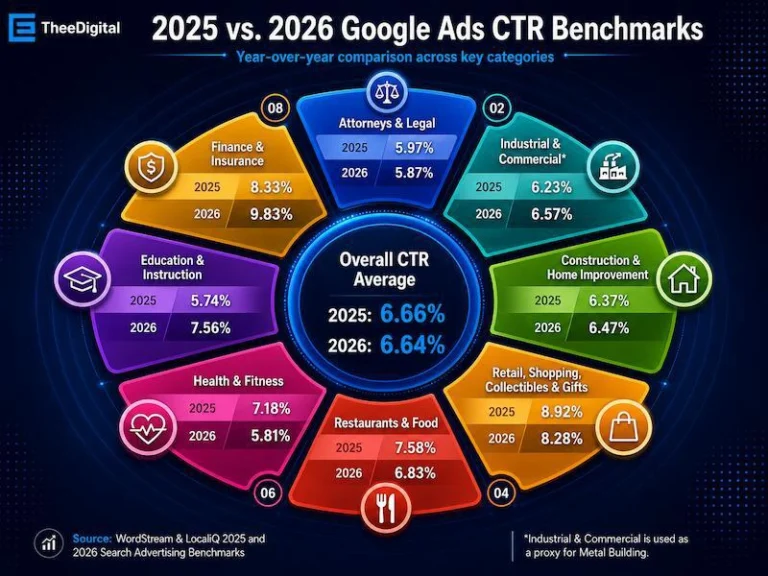
CTR Was Essentially Flat Overall
The average for CTR moved from 6.66% to 6.64%, a difference of 0.02 percentage points. The overall number hides any real variation: education and finance gained ground, while health and fitness and restaurants lost engagement. Read your account by campaign and query type before drawing a conclusion from sitewide averages.
If CTR falls, start with the search terms and ad-to-landing-page match. A lower CTR on a newly added, high-intent campaign is not the same problem as a broad campaign that has started pulling in unrelated searches. PPC advertising needs that level of detail to be useful.
CPC Rose, But Not at the Same Pace as Last Year
Overall CPC went from $5.26 to $5.42. The increase is far smaller than the 2024-to-2025 jump, but it still affects budgeting, especially in legal, home improvement, and other high-cost categories.
Do not respond by lowering bids across the board. First, identify the queries, locations, devices, and service lines that produce qualified leads. Removing a handful of expensive, unproductive terms can be more useful than reducing visibility for the campaigns that actually sell.
Conversion Rate Improved
CVR rose from 7.52% to 8.18% across the full sample. This means that more clicks become tracked conversions, but the improvement only makes an impact when the conversion setup reflects a meaningful business action.
For your business, look for changes in tracking before celebrating this increase. A new click-to-call event, lead form, or automated conversion action can raise reported CVR without adding another qualified customer. Review your CRM outcomes alongside the Google Ads report to get a clearer picture of your industry.
CPL Declined for the First Time in Five Years
Average CPL dropped from $70.11 to $66.69. That is the headline figure for 2026, but it is still only a starting point. Retail and health and fitness saw higher CPLs, while education and finance saw lower ones.
For lead-generation accounts, review the path after the form fill or call:
- How many leads meet the basic qualification criteria?
- How quickly does someone respond?
- How many people schedule an estimate, appointment, or consultation?
- How many become customers, and what revenue do they produce?

What to Review Before You Change Your 2026 Google Ads Budget
Before raising a daily budget, changing bids, or adding new keywords, look at what happens after someone clicks. A campaign may be generating plenty of activity, but that does not always mean it is bringing in the right calls, leads, or sales.
Review the numbers alongside your company’s lead quality, response time, close rates, and profit margins. Those details give you a better basis for deciding whether to spend more, tighten targeting, or adjust the offer.
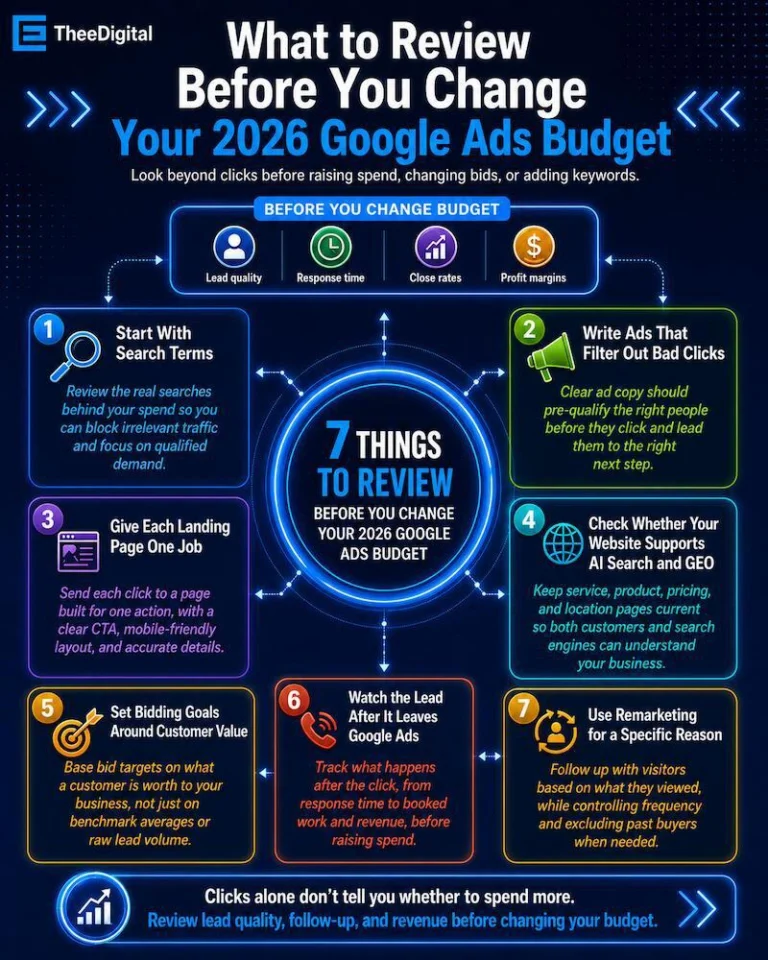
Start With the Search Terms, Not the Dashboard Summary
Before making budget changes, check the actual searches that triggered your ads:
- Sort search terms by spend
- Flag searches that produced no qualified calls, sales, or appointments
- Look for searches outside your service area
- Review search terms closely after using broad match, AI Max, or Dynamic Search Ads
- Add negative keywords only for clearly irrelevant searches, such as “DIY” for an emergency plumbing campaign or discontinued products for a retailer
Write Ads That Filter Out the Wrong Clicks
Your ad should help people decide whether your business is a fit before they click:
- Name the service, product, or offer clearly
- Include your location or service area when relevant
- Mention pricing, financing, hours, or eligibility details when they may affect the decision
- Use a clear next step, such as “Request an Estimate” or “Shop Available Products”
- Match the ad message to the landing page: emergency roof repair and roof-replacement financing should not use the same copy
Give Each Landing Page One Job
A paid click should land on a page built for the action you want the visitor to take:
- Send quote-seekers to a quote or estimate page
- Send shoppers to a product page with price, availability, shipping details, and a clear path to purchase
- Check the page on a phone, not just a desktop screen
- Make the phone number, form, and main call to action easy to find
- Confirm service areas, product details, and confirmation messages are accurate
- Avoid sending every visitor to the homepage
Check Whether Your Website Supports AI Search and GEO
AI Overviews and AI Mode can affect how people research before they click. Your website should give both searchers and Google clear, useful information:
- Keep service pages, product details, pricing, policies, and location information current.
- Answer common customer questions directly on the page
- Add original details that show real experience, such as process information, product specifications, service limitations, or customer concerns
- Make sure important pages can be crawled and indexed
- Keep your Google Business Profile and Merchant Center information accurate, where applicable
- Do not rely on AI-only shortcuts or special markup to replace solid SEO and useful page content
Set Bidding Goals Around What a Customer Is Worth
Bid targets should be based on your own numbers, not a benchmark alone:
- Review your average sale, gross margin, close rate, and available capacity
- Decide how much you can afford to spend to gain one customer
- Use target CPA only when your conversion tracking is reliable and lead volume is consistent
- Consider conversion-value or target ROAS bidding when products or leads have very different values
- Do not treat every form submission or phone call as equal
Watch the Lead After It Leaves Google Ads
Google Ads can show that someone called or submitted a form. It cannot show whether that person became a customer unless you track the follow-up:
- Compare qualified and unqualified leads
- Review missed calls and response times
- Track booked appointments, sales opportunities, and closed revenue
- Look for patterns by campaign, keyword, location, and service type
- Use the findings to decide where to increase spend, tighten targeting, or pause weak campaigns
Use Remarketing for a Specific Reason
Remarketing campaigns work best when the ad reflects what the person already viewed or started:
- Remind quote-request visitors to finish their request
- Show product-focused ads to people who viewed a product or category page
- Use testimonials, reviews, or case studies for people researching a larger purchase or service
- Exclude people who have already purchased or become customers when appropriate
- Watch ad frequency so the same message does not follow people too often
- Review consent requirements and update creative regularly
Review Your Google Ads Data Before You Spend More
Benchmark data can show whether a result is unusual. It cannot tell you whether your clicks are coming from the right people or whether your team has the capacity to follow up. Before increasing spend, look at search terms, lead quality, landing-page behavior, call handling, and the revenue that came from the campaign.
At TheeDigital, our marketing and PCP strategists help businesses audit paid-search accounts, improve targeting and landing pages, and tie campaign reporting to business outcomes. We serve businesses nationwide with Google Ads management, SEO, web design and development, social media marketing, content marketing, email marketing, and conversion rate optimization services.
Spending to Much on Google Ads?
Talk with a member of Raleigh’s top-rated SEO marketing company about a Google Ads review and a free 30-minute consultation.
Tags: Paid Search Marketing • Google

Daniel Falco
Daniel is a digital marketing strategist at TheeDigital. He is an expert in digital advertising and small business marketing strategy, and he aims to fully understand his client’s business and industry to find unique competitive advantages.