Are You Looking to Ramp Up Your Pay-Per-Click Campaigns?
The search industry continues to evolve as AI, automation, and changing user behavior reshape digital advertising. Understanding the latest search industry trends is critical for businesses that rely on paid search, SEO, and digital marketing to generate leads and stay competitive. In an increasingly competitive world, you want to make sure you’re getting the most out of your ad budget. But with new Pay-Per-Click (PPC) trends emerging all the time, it can be hard to know which ones are worth paying attention to.
Not sure where to start? Read on for 17 PPC trends and strategies you should use in 2026 and beyond.
Search Industry Trends in 2026
The search industry is evolving rapidly as AI, automation, and changing user behavior reshape digital marketing. Major search industry trends include AI-driven advertising, omnichannel search strategies, first-party data tracking, short-form video discovery, and automation in campaign optimization.
Top Search Industry Trends
- AI-powered advertising automation
- Omnichannel search strategies
- First-party data and privacy-first tracking
- Short-form video search and discovery
- Performance-focused AI campaign optimization
- PPC Automation
- Omnichannel Marketing Is the New Standard
- What is Target CPA and ROAS?
- AI + Automation Will Power PPC Strategy in 2026 (Not Just Bidding)
- Creatives Make or Break a Social Campaign
- Enhanced Conversions in Google Ads
- Top of the Funnel is Essential
- Take Google’s “Recommendations” with a Grain of Budget
- AI Max for Search: Is it worth it in 2026?
- What OpenAI Ads Manager Actually Is
- Visual Search Ads
- Short-Form Video Ads Are Becoming a Core Performance Channel
- Remarketing Ads
- SEO and PPC Integration
- Bing Ads
- YouTube Masthead Ads
- Smart Segmentation and Google AdMob
- First-Party Data + Privacy-Forward Tracking Will Be Non-Negotiable in 2026
- “Nano Banana Pro” in Google Ads?

1. PPC Campaigns
PPC automation continues to transform how businesses manage and optimize their ad campaigns, with advancements in AI making these tools more sophisticated than ever. Platforms like Google Ads and Microsoft Advertising have introduced enhanced machine learning capabilities, offering features such as predictive audience targeting, dynamic ad creation, and real-time bidding optimizations.
To capitalize on the latest automation trends, businesses should prioritize feeding the algorithms with high-quality data. Accurate conversion tracking, compelling ad copy, and well-defined audience segmentation remain crucial. In 2026, leveraging first-party data will become even more essential as privacy regulations reshape the digital advertising trends landscape.
While PPC automation can handle many repetitive tasks, such as bid adjustments and performance monitoring, it’s vital to maintain strategic oversight. Regularly reviewing campaign settings and performance ensures the AI aligns with your specific goals and prevents costly missteps. By combining human expertise with cutting-edge automation, businesses can unlock both efficiency and scalability while staying competitive in the ever-evolving PPC ecosystem.
How Search Industry Trends Are Changing PPC Campaigns
Search industry trends are reshaping how PPC campaigns are planned, optimized, and measured. As automation, AI-driven bidding, and evolving search behavior become more common, advertisers must adapt their strategies to remain competitive. Modern PPC campaigns now rely on stronger data signals, cross-channel visibility, and conversion-focused optimization to reach users at the right moment. Businesses that understand these search industry trends can improve ad performance, capture higher-quality leads, and stay ahead of competitors in increasingly competitive search results.
2. Omnichannel Marketing Is the New Standard
For years, “PPC strategy” often meant running Google Search campaigns, maybe adding remarketing, and calling it done.
That’s no longer enough.
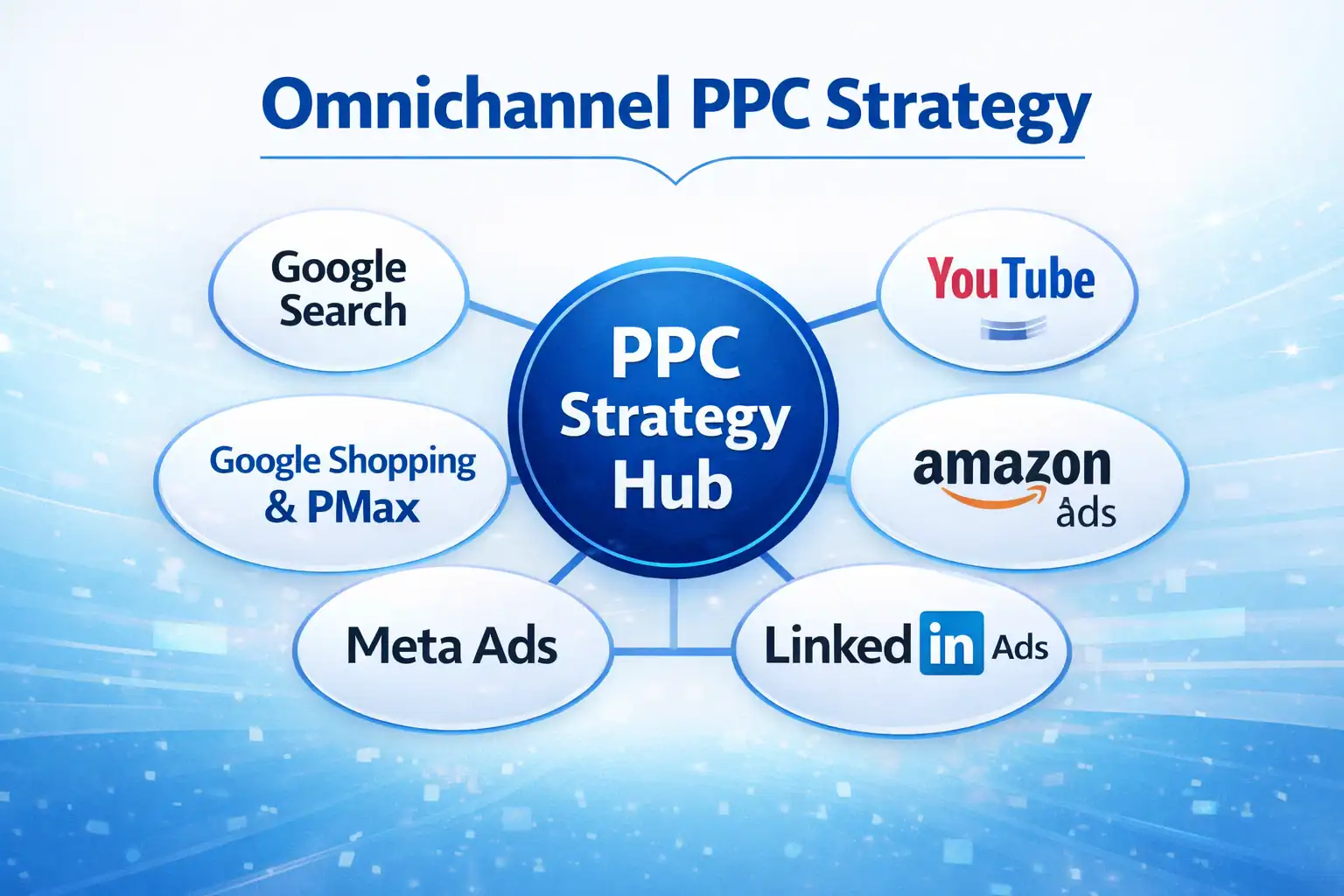
In 2026, high-performing paid media strategies run across ecosystems, not platforms. The standard approach is shifting toward an omnichannel mix that includes:
- Google Search + Shopping + YouTube + Performance Max
- Meta (Facebook + Instagram)
- Microsoft/Bing (especially for lower CPC opportunities)
- LinkedIn for B2B targeting
- Amazon and retail media where product discovery is happening
- TikTok + YouTube Shorts for performance video campaigns
- Recently, Open AI ads in ChatGPT.
The reason is simple: attention is fragmented, and algorithms reward advertisers who stay active across multiple touchpoints. The buyer journey rarely happens in one channel anymore.
Your prospects are constantly moving between platforms — they might discover a brand through a short-form video on Instagram, search for reviews on Google later, get retargeted on YouTube, and finally convert after seeing a testimonial ad on Facebook or a competitor comparison through Search.
At the same time, ad algorithms reward advertisers who stay active across multiple touchpoints because it gives platforms more behavioral signals to learn from. When your brand shows up consistently across channels, the algorithms can better predict who is likely to engage, click, and convert — which leads to stronger optimization, more efficient delivery, and more stable results over time.
In short: brands that advertise everywhere their audience spends time aren’t just more visible — they’re easier for the algorithm to optimize.
Omnichannel PPC wins because it aligns with how people actually buy — and how platforms now measure performance.
3. What is Target CPA and ROAS?
Manual bidding has become a relic of the past! As we move into 2026, smart bidding has become more powerful, and strategies utilizing it are more prevalent.
Smart Bidding is a machine learning-controlled automated bidding system. It uses machine learning to optimize conversions and conversion values in auctions. Some examples include Enhanced Cost-Per-Click (CPC), Target Cost-Per-Acquisition (CPA), and Target Return on Advertising Spend (ROAS).
Every business is different, but for many small businesses, Maximize Conversions with Target CPA would likely be the best fit for a bidding strategy.
According to Google, Target CPA is an automated bid strategy that sets bids for you to get as many conversions or customer actions as possible. When you select the Target CPA (cost-per-action) bid strategy, you set your desired average cost per conversion. Google Ads uses your Target CPA to set a bid based on the likelihood of the ad to convert. So, if you know how much a conversion (phone call, form submission, etc.) is worth, you can set that as the CPA target.
Some of you may not have hard cost-per-conversion numbers to reference, but, in concert with PPC Trends #1 and #2, AI automation comes into play. If given enough data, meaning your ad campaigns must run for a time (depending on budget and campaign success), Google’s algorithm will identify the best guess as a Target CPA. Google also recommends turning auto-apply for “Adjust CPA Targets Automatically” in your recommendations list.
4. AI + Automation Will Power PPC Strategy in 2026 (Not Just Bidding)
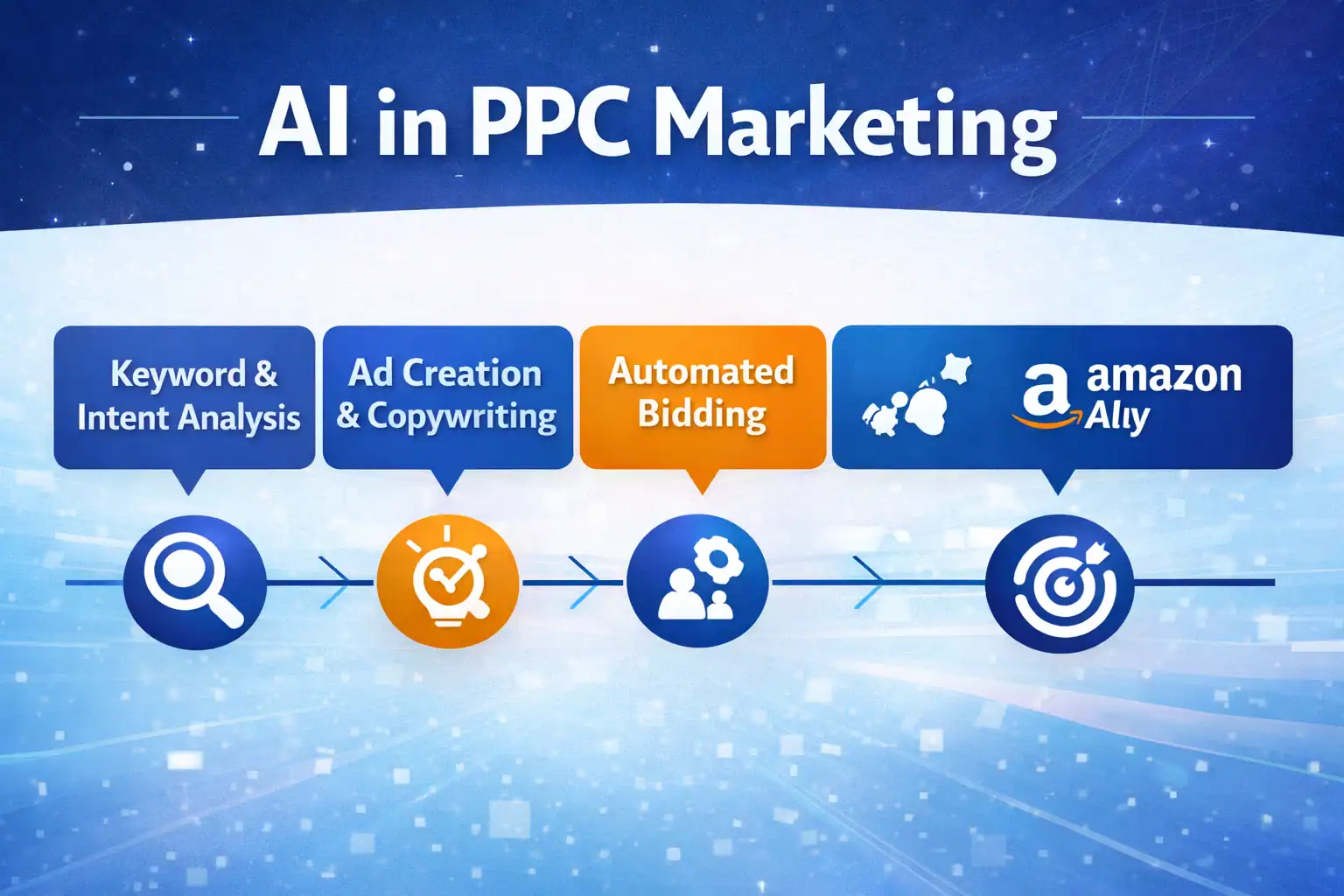
In 2026, AI isn’t just improving bidding, it’s shaping how PPC campaigns are built, optimized, and scaled end-to-end. Platforms like Google and Meta are pushing automation-first campaign types not because they’re simpler, but because they outperform manual management when fed the right inputs. The competitive advantage is no longer who can tweak the most settings it who understands the search industry trends holistically, and who can build a system that helps AI learn faster and drive higher-quality outcomes.
(h3) Creative Generation + Testing at Scale
AI is redefining creative and testing first. Instead of running a handful of static ads and slowly A/B testing minor variations, advertisers now need a steady pipeline of new hooks, formats, and messaging angles. Automation-driven campaigns dynamically assemble and test headlines, images, and video combinations, learning what performs best across different audiences and placements. Creative testing is no longer a separate task — it’s baked into delivery, and advertisers who consistently produce fresh variations will scale faster than those relying on occasional campaign refreshes.
Keyword and Intent Targeting Is Becoming Predictive
Keyword strategy still matters, but platforms are shifting from keyword precision to intent prediction. AI interprets broader signals — landing page relevance, user behavior, device, timing, and historical engagement — to determine who sees your ads. That’s why broad match and automated targeting options continue to gain ground. In 2026, winning advertisers won’t necessarily have the most granular keyword lists; they’ll have campaigns structured around clear intent themes and aligned offers that help platforms interpret relevance.
Bidding + Budget Allocation Is Now Algorithm-Led
Smart bidding has matured, but automation now controls budget allocation at a higher level — distributing spend across placements, audiences, and campaign types based on predicted conversion likelihood. This makes campaign structure and signal quality critical. If you optimize for shallow actions like low-quality form fills, AI will scale volume without revenue. The best advertisers are shifting toward deeper conversion goals like qualified leads, booked calls, and closed-won outcomes using CRM integrations and offline conversion imports.
Audience Modeling Replaces Manual Targeting
Finally, audience targeting is becoming more AI-modeled and less manual. With privacy changes limiting third-party tracking, platforms rely on predictive audiences built from engagement and first-party data. In 2026, the strongest PPC strategies and search industry trends will combine broad reach with clear messaging, strong exclusions, clean conversion tracking, and first-party data integrations that improve modeling and efficiency.
5. Creatives Make or Break a Social Campaign
Strong visuals, sharp copy, and clear messaging are what capture attention and drive action in social ad campaigns like Meta or LinkedIn. A great offer means nothing if your creative doesn’t stop the scroll. That’s why successful brands treat their creative assets as strategic tools—not just decoration.
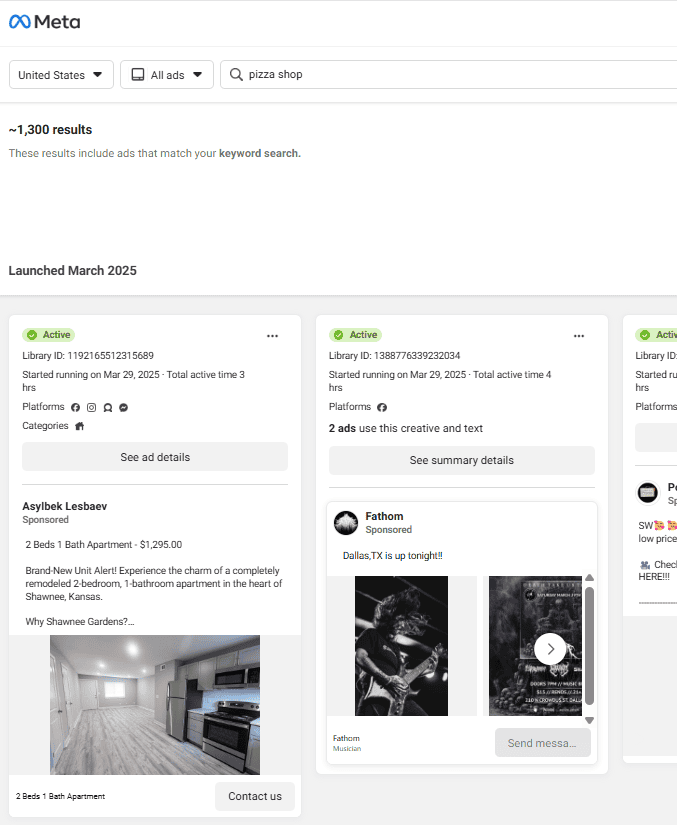
But it’s not just about making something “pretty.” It’s about knowing what works and studying your market. One smart way to level up your creative is to study your competition. The Meta Ad Library lets you see what kinds of ads your competitors are running—how they position their offers, what visuals they use, and how often they’re testing new concepts. It’s a free and legal way to reverse-engineer what’s working in your niche.
Use it regularly. Keep your creative sharp, relevant, and competitive. In the end, your creative isn’t just content—it’s performance.
6. Enhanced Conversions in Google Ads
Enhanced conversions are becoming a key part of smarter Google Ads tracking. In short, they help you get more accurate conversion data by securely sending hashed first-party customer data—like email or phone number—back to Google when a user completes a conversion (like filling out a form). Google then matches this data with signed-in users to better track who took action, even across devices.
Why does this matter? With third-party cookies on the way out, Enhanced Conversions help fill in the gaps, giving you a clearer picture of your ad performance—and helping Google’s machine learning optimize more effectively.
Implementation is fairly straightforward. If you’re using Google Tag Manager, it involves enabling Enhanced Conversions in your conversion action settings, then configuring your tags to capture user data. Google Ads also supports implementation via the global site tag or through API if you’re more technical.
It’s a quiet upgrade—but a powerful one in a privacy-focused future.
7. Top of the Funnel is Essential
When your brand is new or relatively unknown, top-of-funnel (TOFU) paid advertising is essential. Think of it as the first handshake—it’s how you introduce yourself to potential customers who didn’t even know they were looking for you. TOFU tactics focus on awareness, not conversions (yet), but they lay the groundwork for long-term performance.
Channels like YouTube, Meta (Facebook & Instagram), and LinkedIn work well here. Use engaging video content, educational carousel ads, or even lifestyle-focused visuals to grab attention. For example, a new skincare brand might run a short video on TikTok or YouTube showing real people using their products with a message like “Not sure what’s causing your dry skin? Here’s what to try.”
The goal isn’t to sell on the first click—it’s to be remembered. With smart targeting and retargeting strategies later, those early interactions can lead to stronger conversions down the line. In short: awareness fuels performance.

8. Take Google’s “Recommendations” with a Grain of Budget
Google Ads is packed with automated “Recommendations” promising better performance. While some suggestions can be genuinely useful—like fixing disapproved ads or improving conversion tracking—others are geared more toward Google’s bottom line than yours. Pushing broad match keywords or increasing budgets might get you more impressions, but not necessarily better results.
It’s important to understand the motivation: Google makes money when people click. Their system is designed to maximize volume—not always efficiency. That doesn’t mean you should ignore all suggestions, but you shouldn’t blindly accept them either.
Instead, treat the Recommendations tab as a starting point. Review each one critically, cross-reference with your actual campaign goals, and test changes before committing. Automation can be helpful, but human judgment still wins when it comes to strategy. In short: Google wants you to spend. Your job is to make sure you’re spending smart.
9. AI Max for Search: Is it worth it in 2026?
AI Max for Search is Google’s AI enhancement layer for traditional Search campaigns. It’s designed to expand keyword reach, automatically generate and rotate creative, and improve landing page selection—helping advertisers capture incremental search demand without fully shifting into Performance Max. For marketers, the appeal is straightforward: you can keep a familiar Search structure while letting Google’s AI broaden reach and optimize faster.
However, the biggest reason many advertisers should be cautious with AI Max in 2026 is also its core feature: it reduces manual control over costs. Because AI Max is built to expand query coverage and push into net-new searches, spend can become less predictable—especially in the early learning phase. If you’re used to managing costs through precise keyword targeting, strict match types, and bid caps, AI Max shifts that control toward automation. Smart Bidding will prioritize hitting a conversion goal (CPA/ROAS) even if it requires more expensive clicks, which can lead to higher CPC volatility, looser budget pacing, and less transparency at the query level compared to tightly managed Search campaigns.
That risk becomes even more pronounced when tracking isn’t airtight. If AI Max is optimizing toward shallow conversion actions like basic form fills, it can scale volume quickly—but not necessarily quality. In that scenario, advertisers may end up paying more per click while generating leads that don’t translate into pipeline or revenue. Even with exclusions and negative keyword controls, the system can still broaden in ways that don’t align with strict cost-control strategies.
Verdict for 2026: Most advertisers should avoid AI Max for Search unless they have strong conversion quality tracking (enhanced conversions, offline imports, CRM feedback loops) and are comfortable trading manual cost control for automation. If predictable CPCs and tightly managed spend are priorities, a structured, traditional Search strategy remains the safer and more controllable approach.
10. What OpenAI Ads Manager Actually Is
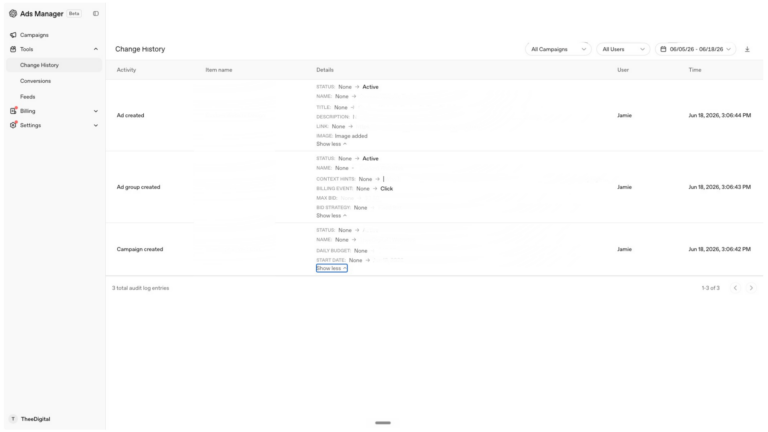
OpenAI Ads Manager Beta is a self-serve platform that lets businesses run paid campaigns directly inside ChatGPT conversations. If you’ve used Google Ads or Meta Ads, the campaign structure will feel familiar: it uses the same Campaign → Ad Group → Ad hierarchy. But the way targeting works is completely different, and that difference matters.
The OpenAI Ads Manager is best used for capturing high-intent users during the consideration and research phases. Because ads appear inside ChatGPT conversations, often after a user has spent several prompts narrowing down what they want (e.g., “Compare the top three CRMs for a small agency”), the traffic it sends is highly qualified. Early performance data shows that while Click-Through Rates (CTR) are lower than traditional Google Search (around 0.6% to 1.5%), the conversion quality is roughly 1.5 times higher once users land on a website.
There are no keywords. There are context hints.
Instead of bidding on search terms, you write plain-language descriptions, called “context hints,” that tell OpenAI’s AI when your business is relevant. The system reads the underlying meaning of a user’s conversation and decides whether your ad fits, not based on the specific words they typed, but on what they actually need.
When a match is found, your ad doesn’t interrupt the experience. ChatGPT answers the user’s question completely first. Once the response finishes, a clearly labeled “Sponsored” card fades in below the answer: your brand logo, a short headline, a brief text snippet, and a link to your landing page. It reads like a natural next step, not an intrusion.
11. A Surge in Visual Searching
Visual search works by using a picture as the search query as opposed to text. For example, you take a picture of a vase you like and the visual search will output links to buy it. People want results faster than ever and visual search helps people get exactly what they want faster than typing in something like “blue vase with painted white flowers”.
Check out Bing’s visual search when we took a picture of a member of TheeTeam’s glasses:
We have already seen Pinterest and Instagram launch products in the visual search arena. Amazon has also shown the value of visual search by partnering with Snapchat.
To stay ahead of this trend, create a photo catalog of your products and services. Add metadata to the images to make sure they are categorized correctly by search engines. For example, a photo of a jade green vase would have alt text like, “small jade green vase.”
12. Short-Form Video Ads Are Becoming a Core Performance Channel

Short-form video is no longer just a brand-awareness play — in 2026, it’s becoming one of the most reliable performance channels across paid social and video platforms. With Instagram Reels, TikTok, and YouTube Shorts dominating attention, advertisers are shifting more budget toward vertical video because it consistently delivers strong reach, efficient CPMs, and high engagement at scale. More importantly, it’s driving measurable conversions when paired with the right creative structure and landing page experience.
The biggest change is that short-form ads now influence every stage of the funnel. Top-of-funnel discovery still matters, but platforms are increasingly enabling mid- and lower-funnel actions through better retargeting, stronger shopping integrations, and improved conversion optimization. In many industries, short-form video is replacing static social ads as the fastest way to test messaging and validate offers — because performance data arrives quickly and creative fatigue is easier to manage with frequent variation.
To succeed, advertisers can’t treat short-form video like repurposed commercials. Winning ads are built for the feed: fast hooks in the first two seconds, clear problem-to-solution storytelling, authentic UGC-style delivery, and strong on-screen text. In 2026, brands that build a consistent creative pipeline for short-form will gain a significant advantage in both scale and efficiency.
13. Remarketing
At its simplest, remarketing is tracking and displaying ads to users once they leave your site. It can be very targeted and personalized, making it a very effective marketing tactic. Showing people ads for things they’ve shopped for in the past, whether they actually made a purchase, tends to result in higher conversions.
Remarketing is about keeping your brand in people’s minds. Things have moved on from trying to appeal to people who are not ready to buy. The focus should be on finding out where your potential customers are in the buying cycle. Then create personalized, targeted ads that will help them decide to convert.
14. SEO and PPC Integration
PPC and search engine optimization and search engine trends go hand in hand. You’ll see better results when you integrate your SEO and PPC campaigns. This is a universal fact that will continue to be true in 2026 and beyond.
A good way to sync up your PPC and SEO is to analyze your top-performing ad copy. Create your content and blog posts based on that copy to boost your ranking.
You can use long-tail terms not only to boost your rankings but also in paid search bidding strategies. SEO and PPC integration allow you to target competitor’s keywords by looking at the PPC Auctions Insights Reports and more.
15. Bing, The Little Search Engine That Could
Bing is back! With its revitalized focus on ad inventory, data, and audience targeting capability, Bing has become a sleeping giant. Recently, Bing Ads rebranded itself as Microsoft Advertising. The latest numbers, as of September 2019, show that 1.3 billion people use Bing worldwide each month. In 2026, ignoring Bing could cost you money.
16. YouTube Masthead on TV Screens
YouTube racks up more than 250 million hours of watch time per day on TV, making it the fastest-growing screen for YouTube. The YouTube Masthead is a digital billboard placed on YouTube’s homepage for 24 hours, on TV screens. This allows advertisers to reach a wider audience. The Masthead will autoplay after a few seconds on all compatible devices.
17. Use Enhanced Measurement to Improve Conversions
Google is on a constant grind to identify more information about the audiences that you want to promote to. Now that Google Analytics 4 has been launched, Google has launched a suite of improvements to Google Ads measurement that can help with that.
Using enhanced conversions is a way to improve accuracy in your conversion data by combining data from your website analytics with advertising data of signed-in Google accounts. Using this feature can greatly enhance Google’s ability to showcase your advertising to the right audience at the right time while reducing spam and increasing budget efficiency.
18. First-Party Data + Privacy-Forward Tracking Will Be Non-Negotiable in 2026

As cookies continue to phase out and privacy regulations tighten, advertisers are facing a new reality: traditional tracking is less reliable, attribution is increasingly modeled, and conversion data is harder for platforms to capture. In 2026, the brands that maintain consistent performance will be the ones investing in first-party data and privacy-forward tracking infrastructure—not just campaign optimizations.
Instead of relying on third-party signals, advertisers are leaning more heavily on tools that strengthen measurement and improve platform learning, including enhanced conversions, CRM and lead list targeting, offline conversion imports, and server-side tracking. These upgrades help platforms connect ad interactions to real outcomes, even when browser-based tracking is limited. They also reduce signal loss, improve attribution accuracy, and enable more effective Smart Bidding and audience modeling.
This shift has major strategic impact. When platforms can measure higher-quality events—like qualified leads, booked calls, or closed revenue—they optimize toward business outcomes instead of surface-level conversions. That results in better lead quality, more stable performance, and fewer wasted dollars on low-intent traffic.
In 2026, first-party data isn’t just an analytics improvement—it’s a competitive advantage. Advertisers who integrate their CRM, strengthen consent-based tracking, and pass back offline conversion data will give platforms better signals, allowing automation to perform at a much higher level.
19. “Nano Banana Pro” In Google Ads
Google recently began rolling out Nano Banana Pro inside Google Ads via Asset Studio, positioning it as its most advanced AI image generation and editing model for advertisers. The goal is simple: remove creative production bottlenecks by letting marketers generate and modify campaign visuals directly within the Google Ads workflow—without waiting on design cycles. Google Business+1
What it is (and what it can do)
Nano Banana Pro is built for high-fidelity, on-brand creative generation, with three headline capabilities:
- Conversational editing: prompt-based edits to an existing image (e.g., seasonal versions, background swaps, layout tweaks)
- Improved product realism and fidelity: better texture rendering and clearer details—especially useful for retail and packaging
- Multi-product lifestyle scenes: the ability to generate cohesive scenes with up to five products in one image Google Business+1
Google has also highlighted improvements in legible text on labels and packaging, which is a meaningful upgrade since most AI image tools struggle here. Google Business+1
This rollout fits a larger 2026 trend: paid platforms are pushing advertisers toward higher creative velocity. With automation optimizing placement, targeting, and bidding, creative becomes the primary performance lever. Nano Banana Pro supports that shift by making it easier to:
- create more variations for testing
- keep campaigns refreshed (reducing creative fatigue)
- produce seasonal/promo updates quickly without full redesign cycles
PPC Marketing Strategies for a New Decade
PPC strategies and search engine trends are constantly evolving. If you want to stay competitive, your marketing strategies need to evolve, too.
Make sure you are always at the forefront of new technologies and best practices. Just because something worked for you last year doesn’t mean it will have as good results in the next.
Like this post? Check out our top digital marketing trends to get your business ready for 2026!
Wondering which PPC strategy is right for your business? Request a free PPC audit from our team to find out. Call +1 919-341-8901 or send us a message here.
The biggest search industry trends include AI-powered search results, automation in advertising platforms, first-party data strategies, and the growing influence of video and visual search. Businesses are also adopting omnichannel strategies as users move between search engines, social platforms, and AI-driven discovery tools.
AI is transforming the search industry by improving how search engines understand intent, generate results, and automate advertising campaigns. AI-powered tools now optimize bidding, personalize search results, and analyze large data sets, helping businesses target the right users and improve marketing performance.
Search industry trends help advertisers understand how users search, what platforms they use, and how algorithms rank content and ads. By adapting to these trends, businesses can improve visibility, reach high-intent audiences, optimize campaign performance, and stay competitive in search results.
Tags: Digital Marketing • Paid Search Marketing • Google

Daniel Falco
Daniel is a digital marketing strategist at TheeDigital. He is an expert in digital advertising and small business marketing strategy, and he aims to fully understand his client’s business and industry to find unique competitive advantages.