
By the TheeDigital AI Search team. Raleigh, NC. Building search visibility for businesses since 2004.
Key Takeaways
- An AI search optimization agency gets your brand cited and recommended inside ChatGPT, Google AI Overviews, Perplexity, Gemini, Claude and Copilot, which is a different job from ranking first in Google.
- Ranking well does not mean getting cited. Only 38% of the URLs that Google’s AI Overviews cite also rank in the top 10, so most citations go to pages that never won the blue link.
- Judge an agency on one thing above all others: whether it can show you a measured citation baseline before the work starts and a measured change after.
TheeDigital is an AI search optimization agency in Raleigh, NC that has been building search visibility for businesses since 2004. We get your brand cited and recommended by the AI platforms your buyers now ask first, and we measure it against a real baseline, including the 72% month-over-month lift in AI search mentions we produced for one national manufacturer.
- Key Takeaways
- What Is an AI Search Optimization Agency?
- AI Search Optimization vs SEO vs GEO vs AEO vs LLMO
- Why Ranking First in Google No Longer Delivers Qualified Leads
- What an AI Search Optimization Agency Actually Does
- How to Choose an AI Search Optimization Agency
- Do You Need an AI Search Optimization Agency Yet?
- How to Measure AI Visibility and Tie It to Leads
- What an AI Search Optimization Agency Costs and How Long Results Take
- Real Results: AI Visibility That Produced Qualified Leads
- What Our Clients Say
- The AI Platforms Your Agency Should Cover
- Industries We Help Win in AI Search
- Why TheeDigital Is the AI Search Optimization Agency to Call
What Is an AI Search Optimization Agency?
An AI search optimization agency is a firm that makes your business the source AI systems cite and recommend when someone asks a buying question. Where a traditional SEO agency works to place a link on a results page, an AI search optimization agency works to put your brand inside the answer itself, across Google AI Overviews, ChatGPT, Perplexity, Gemini, Claude and Microsoft Copilot.
The work breaks into four areas: AI overview and chat optimization, entity and schema markup, topical authority, and prompt and query mapping. Each one is explained further down this page.
One distinction is worth making early, because the market blurs it constantly. An AI visibility platform is software that measures whether you are being cited. An AI search optimization agency is a team that changes the answer. The software tells you that six competitors get named on a prompt and you do not. It cannot write the content, restructure the entity data, or earn the third-party signals that fix it. Both have a place, and we use monitoring software daily as part of our own practice, but a dashboard on its own has never moved a citation.
That gap is the whole reason this category exists. A large and growing share of Google searches now return an AI Overview, and the answer is often delivered without a click. If your business is not represented in that answer, the visibility you spent years building simply is not doing the same work it used to. Structured data helps these systems parse what your business is and what it does, which is why Google’s structured data documentation has become required reading for anyone serious about this channel.
AI Search Optimization vs SEO vs GEO vs AEO vs LLMO
These five terms overlap heavily and vendors use them inconsistently, which is a genuine source of confusion when you are comparing proposals. Two agencies can sell you the identical scope of work under different acronyms. Here is how the terms actually break down.
| Term | What it optimizes for | Primary surface | How success is measured |
| SEO | Ranking position for a keyword | Traditional Google results | Rankings, organic sessions, conversions |
| AI Search Optimization | Being cited and recommended in AI answers | All AI answer surfaces | Share of prompts where your brand appears |
| GEO (Generative Engine Optimization) | Inclusion in generated answers | Generative engines | Citation count and citation share |
| AEO (Answer Engine Optimization) | Being the direct answer to a question | Answer boxes, voice, AI chat | Answer capture rate |
| LLMO (Large Language Model Optimization) | How models represent your brand | Model outputs generally | Brand mention accuracy and sentiment |
The practical takeaway: when an agency uses one of these labels, ask what it measures. The measurement column is where the differences become real. A vendor who cannot tell you what number goes up is selling you a label, not a service.
Why Ranking First in Google No Longer Delivers Qualified Leads
The objection we hear most often is a fair one. We already rank first for our main terms. Why does any of this matter?
Because ranking and being cited run on different systems. Only 38% of the URLs cited in Google’s AI Overviews also rank in the top 10 for that query. Read that the other way around and the point lands harder: the clear majority of AI citations go to pages that did not win the blue link. Holding position one is no longer evidence that you are present in the answer, and in a growing share of searches the answer is all the buyer ever sees.
That is the zero-click problem. The AI summary resolves the question in the interface. Nobody clicks. The visit that used to become an inquiry never happens, and because your rankings have not moved, nothing in a traditional report tells you it is happening.
There is a second effect that matters more for lead quality than for traffic volume. When a buyer asks an AI platform which vendor to use and your brand comes back by name, that buyer arrives already sold on your credibility. They are not comparison shopping from a list of ten blue links. They are checking out a recommendation. That is a materially different conversation for your sales team, and it is why qualified leads from AI search tend to convert at a different rate than generic organic traffic.
As our team puts it: “Businesses that rank well in traditional search but are not structured for AI citation are leaving visibility on the table.”
The natural next question is how you would even know whether this is happening to you. That is a measurement problem, and it is answerable. We cover it below.
What an AI Search Optimization Agency Actually Does
Four capability areas make up the work. If an agency cannot speak concretely to all four, it is doing a portion of the job.
AI overview and chat optimization. Restructuring pages so that individual passages can be lifted cleanly as answers. In practice this means direct, declarative answers placed near the top of a section, question-shaped headings, and self-contained paragraphs that still make sense when pulled out of context. A sentence beginning “it depends on several factors” cannot be quoted. A sentence beginning “AI search optimization is” can.
Entity and schema markup. Making your business machine-legible. That means a consistent, connected set of structured data covering the organization, its services, its location and its FAQ content, so a model can resolve what you are, what you sell and where you operate without guessing. Our working set is Organization, Service and FAQPage, validated rather than assumed. See our guide to schema markup for AI search for the detail.
Topical authority. Building enough genuine depth on a subject that models treat your domain as a reliable source on it. This is the slowest of the four and the hardest to fake, which is exactly why it works.
Prompt and query mapping. The unit of work here is a conversational prompt, not a keyword. We maintain a tracked prompt set the same way a traditional SEO program maintains a keyword set, then monitor which prompts surface your brand and which surface competitors. Buyers ask AI platforms long, specific, multi-step questions, and those questions rarely resemble the short keywords in a rank tracker.
For the full detail of how we deliver each of these, see our AI search optimization services.
How to Choose an AI Search Optimization Agency
Most published guidance on this question is written by agencies that rank themselves first. So here is a framework you can apply to any firm, including ours, and use to disqualify us if we do not measure up.
1. They can show you a citation baseline before any work starts. This is the single most important filter. An agency should be able to tell you, before you sign anything, which prompts your competitors get named on and which ones you are absent from. If nobody measures where you start, nobody can prove where you got to.
2. They treat SEO and AI search as one system, not an upsell. The signals overlap heavily. Content quality, site structure, entity clarity and third-party authority feed both. An agency selling “AI search” as an entirely separate product bolted onto a separate retainer is usually repackaging work you are already paying for.
3. They track prompts, not just keywords. Ask to see the tracked prompt list. If the reporting is a rank-tracker export with a new cover page, the agency has not actually changed what it does.
4. They can connect AI referrals to pipeline. Sessions are not the goal on a channel built around zero-click behavior. Ask how they attribute an inquiry that started in a chat interface, and whether their reporting distinguishes AI referral traffic from general organic. Google Analytics referral documentation covers the mechanics, but the agency should have a considered answer.
5. They publish their methodology. If you cannot tell what an agency actually does from its own website, that is information.
6. They have operating history beyond the recent gold rush. A great many AI SEO agency brands appeared after 2024. Some are excellent. But durable search visibility is built on fundamentals that predate generative AI, and an agency that has managed clients through several major algorithm shifts brings judgment that a two-year-old firm cannot have yet.
Questions to Ask Before You Sign
Take these into any sales call, ours included.
- What is my current citation count, and on which specific prompts?
- Which competitors currently appear on those prompts instead of me?
- What exactly will you change in the first 60 days?
- How do you define and count a citation?
- What happens to my existing Google rankings while you do this work?
- Who writes the content, and are they subject-matter literate in my industry?
- What does month seven look like if everything goes well?
- What would make you tell me not to hire you?
Red Flags to Watch For
Guaranteed AI placement. Nobody can guarantee it. These systems are non-deterministic and the same prompt can return different answers to different users on the same day. A guarantee is either a misunderstanding of the technology or a deliberate misrepresentation.
Pricing quoted with no baseline audit. A number produced before anyone has looked at your current citation position is a package price, not a scope.
Citation counts reported without the prompt set attached. “You were cited 40 times this month” is meaningless unless you know which questions produced those citations and whether they are questions buyers actually ask.
Traffic-only reporting. On a channel whose defining characteristic is that people do not click, a report built entirely on sessions is measuring the wrong thing.
If this framework has clarified what you should be asking for, we are happy to run the baseline audit itself, at no cost, whether or not you go on to work with us.
Do You Need an AI Search Optimization Agency Yet?
Not every business does, and we would rather tell you that now than six months into a retainer. You are probably ready if three or more of these are true.
- Your buyers research vendors before contacting you, and your sales cycle involves comparison
- You already rank reasonably well in traditional search, so the fundamentals are in place
- Your competitors are getting named in AI answers on questions central to your category
- You sell a considered purchase rather than an impulse one
- You have content worth citing, or the capacity to produce it
- You can commit to at least two quarters, because this does not resolve in weeks
If you are a brand-new site with no organic footprint, or your traffic problem is really a conversion problem, standard search engine optimization or lead generation work will produce more for you right now. We will say so.
How to Measure AI Visibility and Tie It to Leads
The most common reason businesses avoid this channel is that they do not believe it can be measured. It can. There are three layers, and a competent agency reports on all three.
Layer one: prompt share. Of the prompts you care about, what percentage return an answer that names your brand? This is your visibility baseline. It is tracked against a defined prompt set and it moves slowly, which makes it a reliable signal rather than a noisy one.
Layer two: citations and source pages. When you are cited, which page earns it? This tells you what to build more of. Citation patterns are frequently surprising, and pages that produce citations are often not the pages a traditional SEO program would have prioritized.
Layer three: post-click behavior. When AI referral traffic does land on your site, what does it do? This is the layer nearly everyone skips, and it is where the connection to revenue is made. As our team puts it: “Getting cited is only half the job. We track how visitors from AI platforms actually behave once they land on your site.”
We run AI visibility tracking as a standing part of every engagement rather than as a quarterly add-on, using dedicated AI search monitoring tooling alongside analytics. The relationship between the layers is straightforward: prompt share is the leading indicator, citations are the mechanism, and qualified inquiries are the lagging indicator that pays for the work. If an agency reports only the first, you cannot tell whether any of it is working.
[IMAGE: screenshot of a real AI platform answer citing a TheeDigital client by name, with the citation visible. Alt text: “ChatGPT answer citing a TheeDigital client as a recommended provider.” This must be a genuine, unedited screenshot. Do not mock this up.]
What an AI Search Optimization Agency Costs and How Long Results Take
Almost nobody in this market publishes a price, which makes it hard to know whether you are being quoted fairly. So here is what we see.
Entry-level retainers for dedicated AI search optimization work generally start around $3,500 per month across the firms that publish figures at all. Comprehensive programs at larger organizations run considerably higher. What moves your number:
- Site size and current authority. An established site with real domain strength needs less foundational work.
- How many prompts are in scope. Ten prompts in one service line is a different engagement from two hundred across six.
- Whether content production is included. This is usually the largest single cost line.
- Geographic scope. A single service area costs less than a national footprint.
- Technical starting condition. Sites with sound structure and existing schema start further along.
On timing, be skeptical of anyone promising results in 30 days. Based on our own engagements, content and structural changes typically begin showing movement in 2 to 4 months, and entity and citation building takes 4 to 6 months to compound. The reason is not agency pace. It is that these systems need to encounter your content, and third-party authority signals accumulate on their own schedule.
If you want to model what a digital marketing investment should return before you commit, our ROI calculator and website cost calculator are free to use.
Real Results: AI Visibility That Produced Qualified Leads
Ask any agency for measured AI-visibility outcomes with named clients attached. Here are ours.
| Client | Industry | What changed | Measured result |
| Kaufman Trailers | National manufacturing | WooCommerce redesign plus AI search optimization | 72% increase in AI search query mentions month over month, 48% increase in pages cited in AI search, 30% increase in ChatGPT responses |
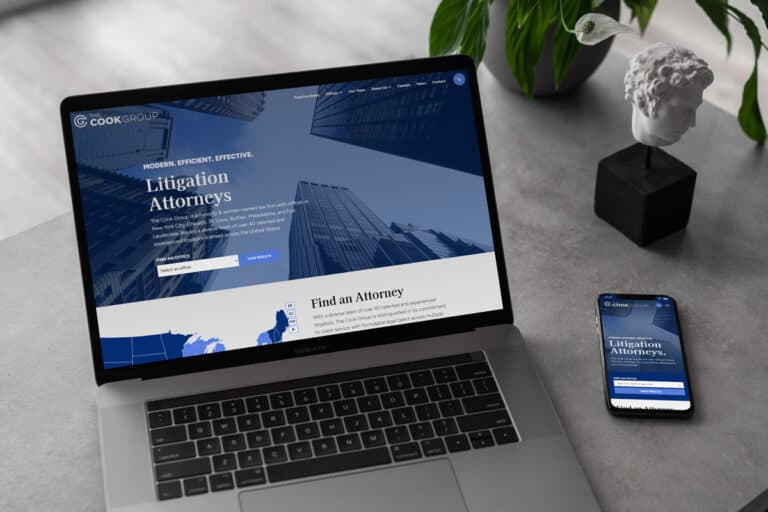
| Advanced Plastiform | Manufacturing | Search and content program | $1 million annual client acquired through the website, #1 rankings for 50 high-value keywords |
| DreamScapes | Landscaping, Raleigh NC | Web design plus AI search optimization | 22% increase in total traffic |
The Advanced Plastiform outcome is the one worth dwelling on, because it answers the question this page is really about. A single client relationship worth $1 million annually came through the website. That is what qualified leads from AI search and traditional search look like when the two are run as one system rather than two budgets.
Full detail is in the Kaufman Trailers case study, the Advanced Plastiform case study and the DreamScapes case study.
See where you stand before you spend anything. We will run a baseline AI visibility audit on your business, show you which prompts your competitors own, and tell you honestly whether this is the right investment for you right now. Get your free AI search audit or call 919-341-8901.
Why Clients Love Working With Us



TheeDigital holds a 4.9 star rating across 119 Google reviews.
“From the beginning, they made everything seamless and easy for me. It’s shocking to think that we completely redesigned and relaunched my website in about 4 weeks, it was completely painless.” – Tyler Watkins
The AI Platforms Your Agency Should Cover
A credible program covers every surface where your buyers ask questions, not just the one that is easiest to measure.
| Platform | Why it matters | What optimization looks like there |
| Google AI Overviews | Appears on a large and growing share of searches, directly above traditional results | Passage-level clarity, structured data, strong topical coverage |
| ChatGPT | The highest-volume conversational assistant for buying research | Citable source content, entity clarity, third-party corroboration |
| Perplexity | Citation-forward by design, links its sources visibly | Authoritative source pages worth linking, current and accurate data |
| Gemini | Integrated across Google’s ecosystem | Overlaps heavily with Google Search signals |
| Claude | Widely used in professional and B2B research contexts | Depth, accuracy, well-structured long-form content |
| Microsoft Copilot | Embedded in Windows and Microsoft 365 workflows | Bing visibility fundamentals plus structured content |
Platform behavior changes often. First-party documentation, such as OpenAI’s published crawler documentation, is the reliable source for how these systems access your site.
Industries We Help Win in AI Search
We work across sectors where the purchase is considered and the buyer researches first. That is where AI recommendation carries the most weight.
- Construction
- Manufacturers
- Law firms
- Healthcare and medical practices
- Manufacturing and metal buildings
- Accounting and professional services
- Roofing and home services
Why TheeDigital Is the AI Search Optimization Agency to Call
We have been doing search since 2004. That is twenty-two years, across every major algorithm shift Google has shipped. A large share of the AI SEO agency brands you will compare us against did not exist three years ago. Generative search is new; earning trust from ranking systems is not.
We are a Google Partner and a HubSpot Partner Agency, rated 4.9 stars across 119 Google reviews, with award recognition including MarCom Gold, the Davey Awards, Horizon Gold, Muse Creative Gold and Vega Digital Silver.
We measure this channel as a practice, not a pitch. AI visibility tracking runs continuously on our engagements, which is why we can put real numbers on this page instead of promises.
We are people you can call. Our office is at 4205 Wake Forest Road, Suite 100, Raleigh, NC 27609, and the phone number is 919-341-8901. We serve the Raleigh, Durham and Chapel Hill Triangle directly and work with clients nationwide.
As we describe our own approach: “We do more than just ‘agency work’ – we act as your partner to develop strategic and comprehensive web and digital marketing solutions.” You can meet the team behind that.
Ready to Show Up in AI Search?
If AI platforms are recommending your competitors and not you, that is a solvable problem, and the first step costs nothing. We will run a baseline audit, show you the prompts where you are absent, and give you a straight answer about whether this is worth your investment right now.
Get your free AI search audit, or call us at 919-341-8901 to talk it through with someone who has been doing this since 2004.
Lead Generation AI Search Optimization FAQs
AI search optimization is the practice of structuring your content, authority signals and technical data so AI platforms cite and recommend your business in their answers. It differs from traditional SEO in its target: the goal is inclusion in the generated answer rather than a ranking position on a results page.
The best AI SEO agency for your business is the one that can show you a measured citation baseline before you sign and a measured change afterward. Rather than trusting any ranked list, including the ones agencies publish about themselves, apply the six criteria above: baseline measurement, integrated SEO and AI strategy, prompt-level tracking, pipeline attribution, published methodology, and real operating history.
There is no single best platform to optimize for, because the right answer depends on where your buyers actually are. ChatGPT carries the most conversational research volume and Google AI Overviews reach the largest general audience, but a B2B manufacturer and a local medical practice should weight them differently. Start by finding out which platforms your inquiries already come from.
Dedicated AI search optimization retainers generally start around $3,500 per month among firms that publish pricing, with comprehensive programs running higher. The figure depends on site size, existing authority, prompt scope, whether content production is included, and geographic reach. See the cost section above for the full breakdown.
Yes, an AI search optimization agency can increase qualified leads, and the mechanism is that buyers who arrive on an AI recommendation are already past the credibility question. For Kaufman Trailers we produced a 72% month-over-month increase in AI search mentions and a 48% increase in pages cited. For Advanced Plastiform, search work produced a client relationship worth $1 million annually.
AI search optimization differs from traditional SEO in what it targets: citation inside a generated answer rather than a ranking position on a results page. The underlying signals overlap substantially, which is why the two should be run as one program, but the measurement is different and so is the content structure. See the comparison table above.
Results from AI search optimization typically begin appearing in 2 to 4 months for content and structural changes, and 4 to 6 months for entity and citation building. Anyone promising meaningful movement in 30 days is describing something other than durable visibility.
Tags: Our Favorites • AI Search Marketing

Jacob Kehler
With over eight years of experience, I am well-versed in all aspects of digital marketing, from website development and SEO to Google Ads and social media management. My expertise includes acquiring organic backlinks, creating optimized content, and driving targeted traffic to websites through effective digital marketing strategies.