
TL;DR:
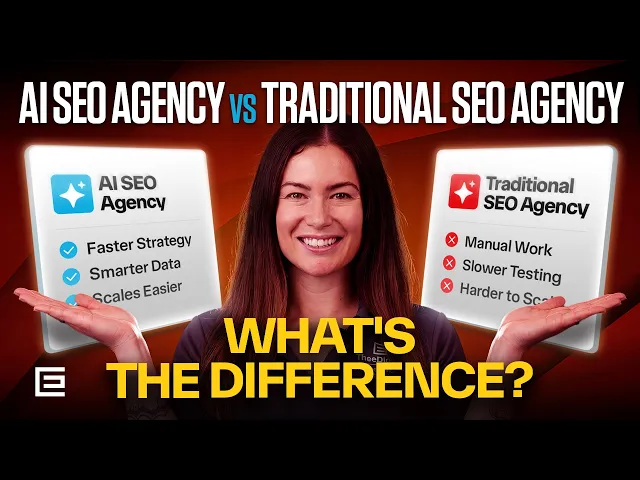
The core difference between an AI SEO agency and a traditional SEO agency is what they optimize for. Traditional agencies focus on Google’s blue-link rankings and organic traffic. AI SEO agencies focus on getting your brand cited inside AI-generated answers from ChatGPT, Perplexity, and Google AI Overviews. Both have real strengths and real blind spots. In 2026, the businesses getting the best results are combining both approaches strategically.
- TL;DR
- What Is an AI SEO Agency?
- What Is a Traditional SEO Agency?
- How Do These Two Models Actually Compare?
- Does AI SEO Actually Drive Business Results?
- What Does Each Agency Type Cost?
- Where Does Each Model Fall Short?
- Which Type of Agency Should You Choose in 2026?
- Differences Between AI and Traditional SEO Agencies
- Frequently Asked AI SEO Agency VS Traditional SEO Agency Questions
Search isn’t what it used to be.
Gartner predicts a 25% drop in traditional search engine volume by 2026 as users shift their questions to AI chatbots. Meanwhile, 68% of Google searches now end without a single click to any website. Your customers are still asking the same questions. They’re just getting answers from very different places.
That shift has created a visible split in the agency world. Traditional SEO agencies are still focused on the familiar building blocks of search engine visibility: backlinks, keyword rankings, technical optimization, on-page improvements, and content designed to perform in Google’s organic results. Those fundamentals still matter, but they are no longer the full picture. AI SEO agencies are now focused on a newer layer of visibility: getting brands cited, summarized, and recommended inside AI-generated answers from tools like ChatGPT, Perplexity, Gemini, and Google AI Overviews.
This practice, often called Generative Engine Optimization (GEO), is less about ranking for a single keyword and more about making a brand easy for AI systems to understand, verify, and trust. Instead of only asking, “Does this page rank on Google?” agencies now have to ask, “Can AI tools identify this company as a credible answer when customers ask for recommendations?
So which approach does your business actually need?
This guide breaks down how each model works, where each one falls short, and why the right answer for most businesses in 2026 probably involves a bit of both.
What Is an AI SEO Agency?
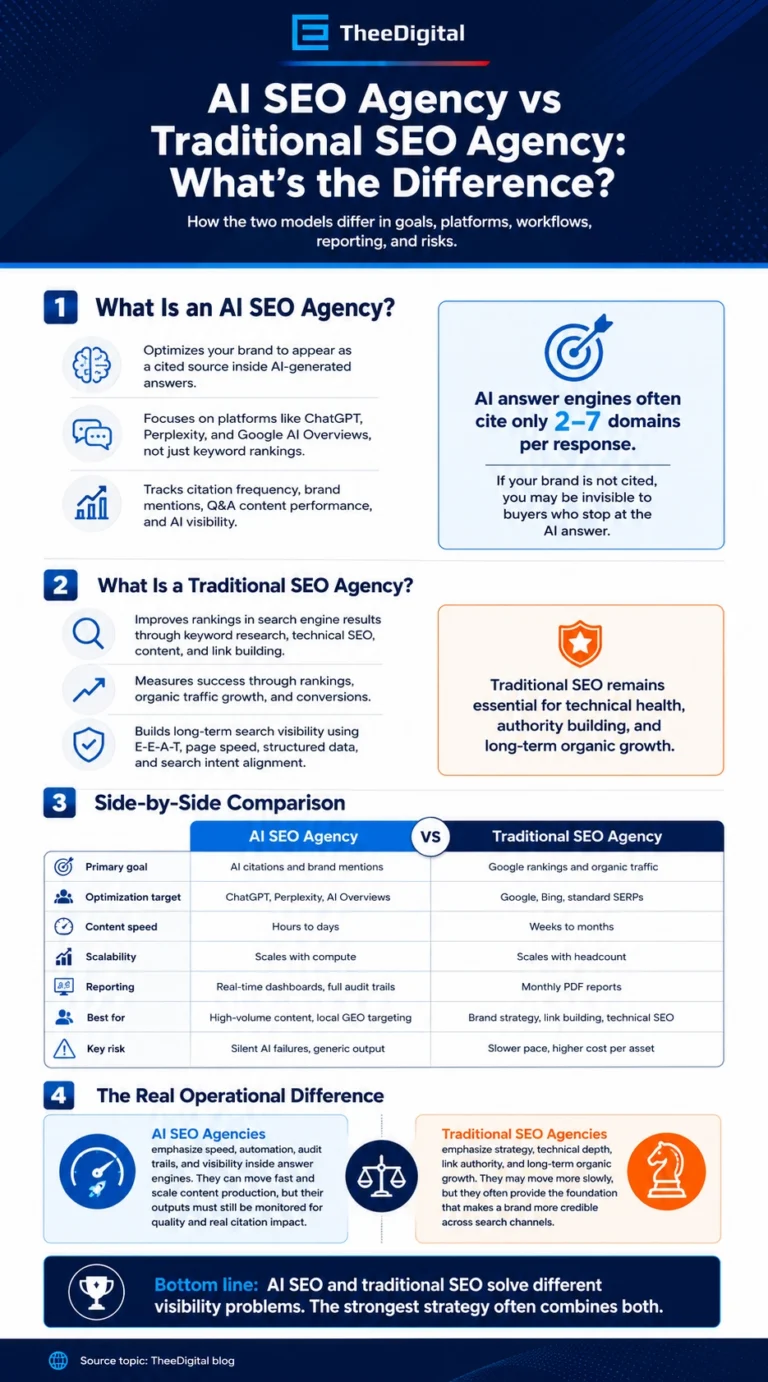
An AI SEO agency optimizes your brand to appear as a cited source inside AI-generated answers, rather than just in traditional search results. These agencies do not focus on keyword rankings. They try to make your content credible. This way, ChatGPT, Perplexity, and Google AI Overviews will mention your brand when answering customer questions.
This distinction matters because AI answer engines typically cite far fewer sources than traditional search results. Instead of showing a full page of options, an AI-generated response may only reference a small group of domains, often just 2 to 7 sources, depending on the query and platform. Compare that to Google’s traditional search results, where users are used to seeing 10 blue links, paid ads, map results, featured snippets, “People Also Ask” boxes, and other opportunities to discover a brand. In AI search, the visibility window is much smaller.
If your company is not included in those citations or recommendations, you may be completely absent from the answer the user sees. That means a growing segment of buyers could make decisions, compare vendors, or form opinions before ever reaching a traditional search results page. For businesses, this makes AI visibility more competitive and more urgent, because being left out of the generated answer can mean being left out of the buyer’s consideration set entirely.
AI SEO agencies use automated systems to publish content in large amounts. They watch brand mentions on AI platforms. They organize content around direct questions and answers. They track how often citations happen as a main performance measure. If you’re exploring what this looks like in practice, TheeDigital offers AI SEO services designed to help your brand earn those citations.
What Is a Traditional SEO Agency?
A traditional SEO agency helps your website rank higher in search engine results, especially on Google. Their work typically starts with keyword research to understand what your customers are searching for, which terms are worth targeting, and how competitive those search opportunities are. From there, they optimize your website’s pages, improve technical performance, build internal links, create a long-term content strategy, and earn backlinks that strengthen your site’s authority. They may also improve metadata, page structure, site speed, mobile usability, crawlability, and conversion paths so your website can attract the right visitors and turn more of them into leads or customers.
Success is usually measured through keyword rankings, organic traffic growth, qualified leads, conversions, and the overall return generated from search visibility.
Traditional agencies have deep expertise in what has driven results for the past two decades: E-E-A-T signals, structured data, page speed, backlink quality, and a content strategy that matches real search intent. They typically take time to understand your brand, your audience, and your competitive landscape before executing.
For most businesses, a full-service SEO program includes technical audits, competitor gap analysis, ongoing content creation, and monthly performance reporting on a retainer model.
How Do These Two Models Actually Compare?
The operational differences between the two agency types go deeper than just the tactics they use:
| Factor | AI SEO Agency | Traditional SEO Agency |
|---|---|---|
| Primary goal | AI citations and brand mentions | Google rankings and organic traffic |
| Optimization target | ChatGPT, Perplexity, AI Overviews | Google, Bing, standard SERPs |
| Content speed | Hours to days | Weeks to months |
| Scalability | Scales with compute | Scales with headcount |
| Reporting | Real-time dashboards, full audit trails | Monthly PDF reports |
| Best for | High-volume content, local Generative engine optimization(GEO) targeting | Brand strategy, link building, technical SEO |
| Key risk | Silent AI failures, generic output | Slower pace, higher cost per asset |
The “black box” criticism of traditional agencies is real. Clients often receive vague monthly reports with limited insight into exactly what work happened during billable hours. AI agencies counter that with complete audit trails and real-time dashboards, but that transparency only helps if someone is actively reviewing it.
Does AI SEO Actually Drive Business Results?
Yes, though not always through traditional clicks. Outbound referral traffic from ChatGPT to websites grew 206% in 2025, according to Semrush. Brands mentioned in AI Overviews saw a 38% increase in organic clicks. They also had a 39% rise in paid ad conversions compared to brands not mentioned.
The compounding pressure is real. AI Overviews now appear on nearly 48% of all search results pages, and when they do, the click-through rate for the number-one organic result drops by 58%. That means strong traditional rankings no longer guarantee the traffic they once did.
Brands that get cited inside AI summaries end up winning twice: they capture the AI mention and still earn clicks from buyers who want to go deeper. Brands that miss both the AI citation and the organic click are getting squeezed from both directions.
Expert Tip: We’ve worked with businesses that assumed shifting to AI SEO would replace everything they’d built in traditional search engines. It rarely does. AI citations and Google rankings reinforce each other. A brand that shows up consistently in both AI answers and organic results builds far more trust with buyers than one that only appears in one place. Before making any major strategic shift, start with a website audit to understand where your current visibility gaps actually are.
What Does It Take to Get Cited by AI Engines?
Getting picked up by AI search comes down to three factors.
Your content needs to answer real questions directly and clearly. AI models are designed to identify the most useful, complete, and easy-to-understand answer to a user’s query. If the answer is buried under several paragraphs of background information, vague introductions, or unnecessary setup, the AI may have a harder time recognizing your content as the best source to reference. Instead, lead with the answer first, then use the rest of the section to explain, support, and expand on it. This makes your content more helpful for readers and easier for AI tools to extract, summarize, and cite.
Your site needs strong E-E-A-T signals. Research shows that 96% of AI Overview citations come from sources with strong Experience, Expertise, Authoritativeness, and Trustworthiness. Author credentials, original data, proper sourcing, and regularly updated content all feed into this.
Your brand also needs to be mentioned across multiple credible platforms, not just your own website. AI models build a picture of authority from many signals at once.
What Does Each Agency Type Cost?
Cost is one of the most misunderstood parts of this conversation.
Traditional SEO agencies charge for people and expertise. Monthly retainers for small to mid-sized businesses typically range from $1,500 to $5,000 per month, and national or enterprise campaigns often cost considerably more.
AI SEO tools and agencies position themselves as dramatically cheaper, with some entry-level platforms starting under $50 per month. The real picture is more nuanced than that.
| Cost Category | Traditional Agency | AI SEO Agency |
|---|---|---|
| Monthly retainer | $1,500 to $5,000+ | $49 to $2,500+ |
| Content production | Slower, higher cost per piece | Fast, cheaper per piece |
| Strategy layer | Included in retainer | Usually requires human oversight |
| Integration and tooling | Minimal | Can add up quickly |
| Rework and error costs | Low (human review) | Can be significant (silent AI failures) |
AI agencies are genuinely 30 to 60% cheaper on production-heavy work like first drafts and reporting. But for strategic decisions, brand positioning, and crisis response, human judgment is still required. Once you factor in oversight costs, integration fees, and fixing output errors, the savings narrow considerably for complex campaigns.
Where Does Each Model Fall Short?
Neither approach is without serious blind spots.
Traditional SEO agencies struggle to keep pace with how fast search is evolving. A local SEO campaign that once took two to three weeks to set up can now be outpaced by an AI system publishing dozens of neighborhood-specific pages overnight. Traditional agencies also scale linearly with headcount: more clients means more staff, which means higher overhead passed back to clients.
Expert Tip: One of the clearest signs an agency is behind the curve is when they measure success only in rankings and traffic, with no mention of AI search visibility, brand citation rate, or zero-click impressions. Those metrics matter now. Any white hat SEO strategy worth investing in should include a way to track whether your brand is showing up in AI-generated answers, not just on page one of Google.
AI SEO agencies carry a different set of risks, especially when they rely too heavily on automation without enough strategic oversight. Automated content can be fast and scalable, but it can also become generic, repetitive, or disconnected from the specific voice, expertise, and credibility that make a brand trustworthy. AI search tools may produce content that looks polished on the surface but lacks the depth, nuance, examples, and real-world insight needed to stand out in competitive search results.
Another challenge is that AI search systems often fail silently. They can generate content that is technically accurate, grammatically clean, and properly formatted, but still underperforms because it does not match search intent, differentiate the business, support conversions, or reflect the brand’s actual authority. Without regular human review, performance monitoring, and quality control, these issues can compound over time. A company may publish dozens of pages before realizing the content is not attracting the right traffic, earning trust, or generating leads.
There’s also a brand safety consideration. If an AI search system publishes content that misrepresents your business or appears in a context you’d never approve, a human has to catch it. That catch-and-fix layer costs time and money that often doesn’t show up in the initial pricing estimate.
Businesses with advanced inbound marketing, complex services, or strict rules need humans to oversee strategy. This is true no matter how much AI does the work.
Which Type of Agency Should You Choose in 2026?
For most businesses, the right answer isn’t choosing one or the other. It’s knowing how to combine both. Hybrid approaches that blend AI automation with human-led strategy consistently outperform single-method approaches, with research showing 70% higher ROI for businesses that get this balance right.
The practical framework is straightforward: use AI platforms for scale and humans for trust.
AI agents are excellent at technical monitoring, keyword clustering, content drafts, and scaling local and national SEO page production. Human strategists are better at brand positioning, digital PR, relationship-based link building, and connecting your SEO and SEO tools to your broader business goals.
The businesses getting the best results in 2026 run a lean human team for quarterly strategy and brand-critical content, while AI search systems handle day-to-day execution at volume.
Expert Tip: When evaluating any agency, whether AI-driven or traditional, ask this one question: “How do you measure success in an environment where most clicks don’t happen?” If they can’t answer with specific metrics tied to AI search visibility, brand citation rate, and zero-click impressions, you’re looking at an agency still operating on 2022 thinking. The right digital marketing strategy for today has to account for both worlds.
Differences Between AI and Traditional SEO Agencies
The difference between an AI SEO agency and a traditional SEO agency comes down to what search environment they’re built for. Traditional agencies are optimized for the world that existed before AI Overviews and ChatGPT reshaped how people find information. AI agencies are built for that new world, but they often lack the human depth needed for brand-critical work.
If you want to stay visible as search engines continues to change, you need both. The real question isn’t “AI or traditional?” It’s “How do we combine the speed and scale of AI with the judgment and credibility that only human expertise provides?”
Frequently Asked AI SEO Agency VS Traditional SEO Agency Questions
An AI SEO agency optimizes your brand to appear as a cited source inside AI-generated answers from tools like ChatGPT, Perplexity, and Google AI Overviews. A traditional SEO agency focuses on improving your rankings in standard search results and driving organic traffic to your website. Both aim to increase your online visibility, but they target different environments and use different methods to get there.
Not entirely, and not yet. Traditional SEO still drives measurable traffic and conversions for most businesses. AI SEO is growing rapidly, with ChatGPT referral traffic to websites growing 206% in 2025 alone, but it works best alongside traditional SEO rather than as a replacement for it. The two approaches reinforce each other when combined strategically.
AI SEO tools and entry-level agencies can start as low as $49 per month, while traditional agency retainers for small to mid-sized businesses typically range from $1,500 to $5,000 per month. The true cost comparison depends on the scope of work. High-volume AI content production is cheaper per piece, but adding human oversight for quality control often narrows the savings significantly for complex or brand-sensitive campaigns.
No. Most businesses use a hybrid model. They use AI for tasks that happen a lot and can be repeated, like writing content drafts, watching technical systems, and grouping keywords. Human strategists handle brand positioning, link building, and campaign direction. Research shows hybrid approaches deliver 70% higher ROI compared to using just one method alone.
You can search your brand name directly in ChatGPT, Perplexity, and Google AI Overviews to see how you appear. Several tools also now track AI brand mentions and citation frequency, including Semrush’s AI visibility reports and DataForSEO’s AI mention tracking. A full-service digital marketing agency can run an AI visibility audit as part of a broader SEO strategy review, giving you a clear picture of where you stand and what to fix first.
Need Help Getting found in AI Search? Get the Free AI Playbook
TheeDigital has been helping businesses navigate digital marketing since 2004. We understand both worlds and can help you build a strategy that performs in 2026 and beyond. Schedule a free audit to talk through your current SEO approach and find out where the gaps are.
Tags: AI Search Marketing • Digital Marketing • Search Engine Optimization

Richard Horvath
Richard Horvath is the founder of TheeDigital, a Raleigh based award-winning web design and digital marketing agency. He is proud of his team and the results that they provide to their clients.