

A website without a system to capture and nurture leads is like having a beautiful storefront with no cash register. People walk in, browse, and leave, without leaving a trace.
If lead generation is critical to your business, HubSpot isn’t just nice-to-have software, it’s the difference between scaling and staying stagnant. More importantly, it’s the difference between leads slipping through the cracks and every single prospect getting the attention they deserve.
- The Lead Generation Reality Check
- What Is HubSpot, Really?
- How Lead Generation Works
- 1. Create Simple Landing Pages
- 2. Offer Something Valuable
- 3. Use Forms & Clear CTAs
- 4. Follow Up Automatically
- 5. Track What's Working
- Your 30-Day Action Plan
- Get help implementing this
- Frequently Asked HubSpot Questions
The Lead Generation Reality Check
Let’s start with the uncomfortable truth: most leads die before they’re ever born. A Harvard Business Review study found that companies responding to leads within one hour are 7x more likely to qualify them. Yet we see businesses every day that are losing leads because they don’t know they came in, forgetting to follow up, spending money on traffic without tracking where it goes, and manually moving lead information between email and spreadsheets (which doesn’t scale).
If this sounds like you, you’re not alone. And the fix is simpler than you think.
What Is HubSpot, Really?

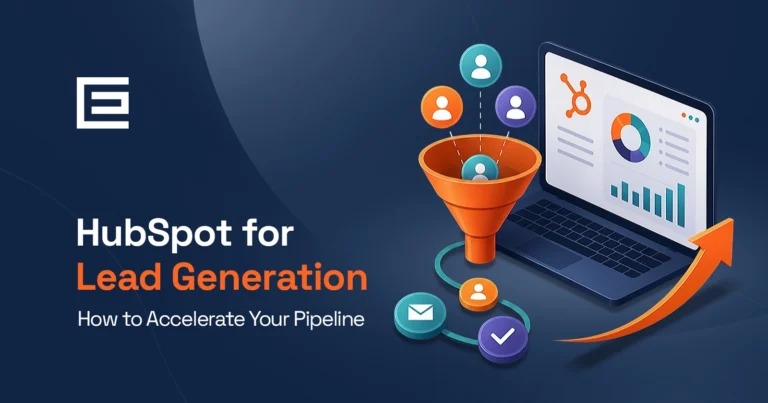
HubSpot is a Customer Relationship Management (CRM) system. But forget the jargon for a second. What HubSpot actually does is give you one central place to:
- Capture leads from your website, phone calls, and other sources
- Store and organize all contact information automatically
- Send marketing emails and track who opens them
- Automate follow-ups so nothing falls through the cracks
- Track what’s working so you know your ROI on every dollar spent
Think of it as your business’s nervous system. Everything connects. Everything flows. Nothing gets lost. And the best part? HubSpot has a free tier. You can get started today without waiting for budget approval.
How Lead Generation Works (The 5-Step Process)
The process is simple. The execution is where most businesses fail. Here’s the cycle:
- Someone visits your website
- They see an offer
- They fill out a form
- You follow up (fast)
- They become a customer
HubSpot’s job is to ensure nothing gets missed in steps 2–4. Without it, leads languish in email inboxes. With it, they get prioritized, tracked, and converted. Here’s the harsh reality: Speed matters. When someone reaches out for your services, they’re comparing you to competitors. The first business to respond usually wins. If it takes you six hours to get back to them, someone else already has.
1. Create Simple Landing Pages
A landing page is where someone gives you their information. That’s it. Don’t overcomplicate it. The goal of a landing page is laser-focused: get the visitor to take one action—download your offer, schedule a call, or request a quote. When you try to do too much on one page, you confuse visitors and they leave without converting.
Why Clarity Matters on Landing Pages
Visitors spend an average of 8 seconds on a webpage before deciding to stay or leave. Your landing page headline needs to tell them immediately: “This is for you, and here’s what you get.” If they have to guess what you’re offering or who it’s for, they’re gone. Clear headlines aren’t just nice-to-have, they’re the difference between a 2% conversion rate and a 15% conversion rate. We’ve seen this play out with our clients repeatedly. The moment we clarify the headline and remove distracting elements, conversions spike.
- Clear, specific headline (“Get Your Free Spring Roof Inspection Checklist” not “Download Now”)
- One main offer only
- Short form — every extra field drops conversion 3-5%
- Mobile-friendly design — 63% of web traffic is mobile
Best Practices for Landing Pages
- Clear headline: Tell them exactly what they’re getting and who it’s for (not “Download Now” but “Get Your Free Spring Roof Inspection Checklist”)
- One main offer: Don’t confuse them with 15 options. Pick one outcome and commit to it.
- Short form: Ask for name, email, phone. Every additional field drops your conversion rate by 3-5%.
- Mobile-friendly design: 63% of web traffic is mobile. Make sure your page works on phones. Test it yourself before launch.
HubSpot’s landing page builder handles this automatically. Forms integrate directly into HubSpot, so when someone submits, the lead pops into your CRM instantly. No manual data entry. No copy-paste errors. No leads lost because someone forgot to write them down.
Action Step
Improve ONE landing page this week. Clear it up. Test it on mobile. If you’re offering a free consultation, audit, checklist, or guide, make that crystal clear above the fold.
2. Offer Something Valuable
Here’s the question you need to ask yourself: “Would I give my email for this?” People don’t trade contact information for nothing. They trade it for value. But here’s where most businesses fail: they create generic offers that don’t resonate with their specific audience.
Examples of Lead Magnets That Work
- Free guides or checklists (specific to a problem)
- Industry reports or benchmarks
- Templates or worksheets (that solve a real problem)
- Webinars or training videos
- Free consultations or audits
Framework: Match Your Offer to Your Audience’s Pain Point
Here’s the real secret to lead magnets that work: match the offer to the specific pain point your prospect is experiencing right now. If you’re a roofing company, don’t create a generic “home maintenance guide.” Create a “Free Spring Roof Inspection Checklist” or “Signs Your Roof Needs Replacement Before Summer.” Why? Because someone searching for roof issues has a specific problem to solve. They’re not browsing—they’re actively looking for answers.
The framework:
- Identify your top 3 services/solutions
- For each, write down the #1 pain point your customers have when they first reach out
- Create an offer that solves that specific pain point (not a generic offer)
- Name it specifically: “Checklist for X” or “Guide to Avoiding Y” beats “Free Report”
Action Step
Pick your top 3 services. Identify the pain point for each. Create one simple, specific lead magnet for each, something that takes 30 minutes but delivers real value. Don’t wait for perfection; launch this week.
3. Use Forms & Clear CTAs
Once you have a valuable offer, the next step is making it impossible to miss. Having a great lead magnet is useless if people can’t find the form to access it.
Where to Place Forms & CTAs on Your Website
- Blog posts: In a sidebar and at the end of the post (related to topic)
- Service pages: Below the service description and before the footer
- Homepage: Hero section and mid-page
- Resource/Resource Hub pages: Highlight above the fold and throughout
Best Practices for Forms & CTAs
- Keep forms short: Every field you add reduces conversions by 3-5%. Ask for name, email, and maybe phone. That’s usually enough.
- Use strong, action-oriented button text: “Download My Free Checklist Now,” “Get Your Audit,” “Schedule My Free Consultation” beats generic “Submit” buttons
- Make CTAs visually distinct: Use contrasting colors. Make them impossible to miss. If your button blends into the background, people won’t see it.
Example CTA Copy That Works
Instead of: “Download” → Try: “Send Me the Free Checklist”
Instead of: “Contact Us” → Try: “Schedule a Free 30-Minute Consultation”
Instead of: “Learn More” → Try: “Get Your Free Audit Now”
Notice the pattern? Specific, benefit-focused, and urgency-driven. Compare “Contact Us” (vague, could mean anything) with “Schedule a Free 30-Minute Consultation” (specific, shows time commitment, mentions it’s free). The second one converts better because prospects know exactly what they’re signing up for.
Action Step
Add CTAs to your top 5 pages THIS WEEK. Pick the offer that matches each page’s topic and link to it prominently. Review your button copy—is it specific and benefit-focused?
4. Follow Up Automatically
Most leads don’t convert on the first interaction. People read your offer. They think about it. They fill out a form. They receive your welcome email. And then nothing. Two weeks later they’ve forgotten about you and moved to a competitor. That’s where automation saves the day.
Welcome email
Deliver the offer. Thank them. Set expectations.
Value-add email
Share a helpful resource. Don’t sell yet.
Soft offer
Invite them to book a call. Make it about them.
Reminder and value
Case study or testimonial. Last easy touch before adjusting approach.
Most leads need 5 to 7 touchpoints before they’re ready to buy. Day 1 is still fresh in their mind. Day 3 is when they’ve had time to use the resource and might have questions. Day 7 is a non-pushy reminder before they forget. Don’t over-automate. People still want to feel like they’re talking to a real human.
5. Track what’s working
If you don’t measure it, you can’t improve it. Track leads per month, conversion rates by page, cost per lead if running ads, email open and click rates, and time from lead to contact (target: under 1 hour).

Red flags to watch for
- Leads dropping month over month
- Conversion rate dropping below baseline
- Email open rates falling below 15%
- Response time creeping above 2 hours
HubSpot’s dashboards let you customize what you see. Stop guessing. Start measuring. Double down on winners. Fix or retire the losers.

Your 30-day action plan
You don’t need to do everything at once. Start simple. Execute one thing well. Then move to the next.
Week 1
- Improve one landing page (clear headline, short form, mobile-friendly)
- Shorten any forms that ask for too much information
Week 2
- Create one lead magnet (checklist, guide, template, audit, etc.)
- Set up one automated email sequence using the framework above
Week 3
- Add CTAs and forms to your top 5 pages
- Make sure every page has a clear next step for visitors
Week 4
- Review results in HubSpot
- Identify what’s working and what’s underperforming
- Plan improvements for next month
Simple beats complicated. One solid landing page with a strong offer and follow-up sequence will outperform 10 mediocre ones. Don’t try to do everything. Execute one thing well, then move to the next.
The bottom line
HubSpot for lead generation isn’t complicated. It’s a system: create simple landing pages, offer real specific value, use forms and CTAs strategically, follow up automatically with personality, and track what works. Every day without a lead generation system is money left on the table.
Get help implementing this
Setting up your HubSpot lead generation system correctly from the start lays the foundation for success. TheeDigital has helped hundreds of businesses establish and grow their online presence. We provide personalized, one-on-one HubSpot training as well as team and departmental training sessions to make sure you are utilizing everything the platform has to offer. We also help set up HubSpot correctly from day one, build landing pages, create automation workflows, and improve lead conversion for businesses just like yours.
Let’s talk. Schedule a free consultation to see how we can help you accelerate your pipeline.
Ready to accelerate your pipeline?
TheeDigital helps businesses set up HubSpot correctly, build landing pages, create automation workflows, and improve lead conversion.
Frequently Asked HubSpot Questions
HubSpot is an all-in-one CRM and marketing platform that helps businesses capture leads through forms and landing pages, organize contact information automatically, send targeted email sequences, automate follow-ups, and track performance across every channel. For lead generation specifically, HubSpot connects your website traffic to your sales pipeline so no prospect falls through the cracks.
Yes, HubSpot offers a free CRM tier that includes contact management, forms, email marketing, and basic reporting. Paid tiers (Starter, Professional, and Enterprise) unlock advanced automation, A/B testing, sequences, and deeper analytics. Most small and mid-sized businesses can get significant value from the free plan before needing to upgrade.
Most businesses begin seeing results within 30 to 60 days of implementing a lead generation system in HubSpot. The timeline depends on your existing traffic, the quality of your lead magnets, and how quickly your follow-up sequences are set up. Businesses that already have consistent website traffic tend to see the fastest results because HubSpot captures and converts traffic that was previously slipping away.
HubSpot works well for B2B service companies, professional services firms, agencies, healthcare providers, home services businesses, and any organization with a longer sales cycle that requires multiple touchpoints before a prospect converts. If your business relies on forms, phone calls, or consultations to generate leads, HubSpot is built for your workflow.
Yes. TheeDigital is a certified HubSpot partner and offers HubSpot implementation, CRM setup, workflow automation, and ongoing training for businesses and teams. We also host free HubSpot training events for business owners and marketing professionals. You can learn more about our HubSpot services or register for an upcoming training session on our website.
HubSpot CRM is the free foundation that stores all your contacts, deals, and communication history. HubSpot Marketing Hub is a paid add-on that adds powerful tools like email automation, landing page builders, lead scoring, and campaign analytics on top of the CRM. Most businesses start with the free CRM and add Marketing Hub features as their needs grow.
Tags: Content Marketing • HubSpot • Lead Generation
Shyanna Kelley
Shyanna collaborates with sales on lead generation efforts and planning and developing compelling digital assets for TheeDigital.