TL;DR: No one can guarantee a citation in Perplexity, Gemini, or Google AI Overviews. What you can control is readiness: crawlable pages, direct answers, credible sourcing, and content structured around real buyer questions. This guide explains what each AI system publicly says about accessing, using, or presenting web sources, shows industry-specific examples, and gives you a way to measure AI visibility and GEO scoring without overpromising results.
- TL;DR
- What Does It Mean to Be Cited by an AI Answer Engine?
- Can You Guarantee Citations in Perplexity, Gemini, or Google AI Overviews?
- What Google Says About AI Overviews, AI Mode, and Supporting Links
- How Perplexity and Gemini Handle Web Sources
- What Makes Content More Citation-Ready?
- Industry Examples: Citation-Ready Content for Service Businesses
- Technical SEO Checks That Support AI Search Visibility
- How to Measure AI Search Visibility Without Overpromising
- Conclusion
- Frequently Asked Questions about Getting Cited in AI Overviews
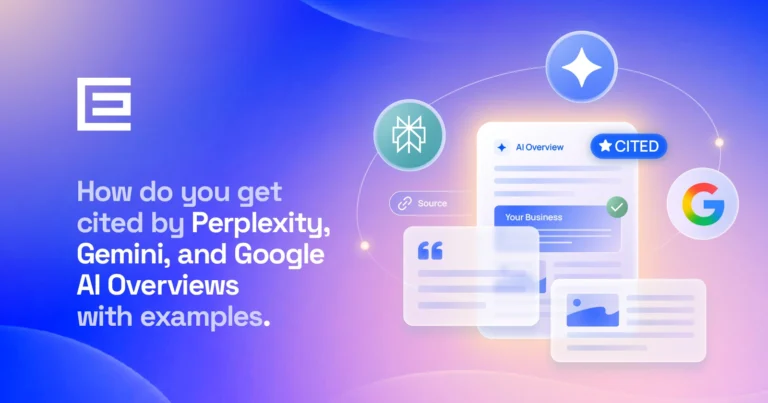
You’ve probably typed a question into ChatGPT or Google’s AI Mode and watched it answer with a summary, a few linked sources, and no need to click through to any of them. If you run a business, that’s unsettling. You want to know how to get cited by Perplexity, Gemini, and Google AI Overviews, not just how to rank on a results page that fewer people are scrolling through.
Here’s the honest starting point: there is no button you can push for a guaranteed citation. Google says meeting its requirements doesn’t guarantee your page gets crawled, indexed, or shown. Perplexity and Gemini don’t publish a source-selection formula either. But that doesn’t mean you’re stuck. Each of these systems has published real, specific guidance about how they access and use web content, and businesses that follow this guidance are better positioned to be discovered, understood, and considered by AI answer systems.
This guide walks through what Google, Perplexity, and Gemini each say, what content structure and technical work actually supports citation potential, and where the industry data still has gaps.
What Does It Mean to Be Cited by an AI Answer Engine?
Being cited by an AI answer engine optimization means your page gets referenced, linked, or used as supporting material inside a generated answer. That can look like a direct link under an AI Overview, a footnote in a Perplexity answer, or a source Gemini pulls in through grounding. It’s different from ranking first in classic search results, and a page can do well in one without doing well in the other.
For a service business, this matters because buyers are increasingly asking AI tools questions they used to type into Google: “how much does X cost,” “do I need a lawyer for this,” “which contractor should I hire.” Being the source an AI tool references at that moment can put your business in front of someone who never opens a traditional search results page. This is the practical difference between traditional search engine optimization and generative engine optimization: SEO focuses on earning visibility in search results, while GEO strategy focuses on making your content easier for AI answer engines systems to reference, summarize, or mention.
Can You Guarantee Citations in Perplexity, Gemini, or Google AI Overviews?
No. AI citations cannot be guaranteed by any agency or any tactic. Google says directly that meeting its technical requirements makes a page eligible, but eligibility doesn’t guarantee crawling, indexing, serving, or inclusion in AI Overviews or AI Mode. Perplexity and Gemini haven’t published a full explanation of how they choose sources either.
That’s an uncomfortable answer if you were hoping for a shortcut. But it’s also the honest one, and it’s worth being direct about which claims are safe to make and which ones aren’t.
Risky Claim vs. Safer Claim
| Risky claim | Safer claim |
|---|---|
| “We guarantee your site will be cited by ChatGPT, Perplexity, or Google AI Overviews.” | “We can improve the technical and content signals that make citation more likely.” |
| “Adding schema markup gets you cited in AI Overviews.” | “Structured data helps Google understand your content and supports rich results; it doesn’t guarantee an AI citation.” |
| “Ranking #1 in Google means you’ll show up in the AI Overview too.” | “Ranking well helps, but a growing share of AI Overview citations come from pages outside the top 10.” |
| “An AI answer engine picks sources the same way.” | “Google, Perplexity, and Gemini each have different access methods and disclosed only partial information about source selection.” |
| “One optimized blog post fixes your AI visibility.” | “AI visibility depends on ongoing technical access, content quality, and credible sourcing across your site.” |
TheeDigital Proof Point: Kaufman Trailers
It helps to see what this work looks like in practice, with the caveat up front: this is one published result from one client, not a promise of what every business will see.
TheeDigital optimized the content freshness and technical structure for Kaufman Trailers, a national trailer manufacturer, and tracked a 72% increase in AI search query mentions, a 48% increase in pages cited across AI search platforms, and a 30% increase in ChatGPT search responses. These results should still be treated as one published client example, not as a guaranteed outcome for every business. The work focused on the things that are actually within a business’s control: clearer page titles and headings, stronger internal linking, and content built around the questions buyers were already asking AI tools like Perplexity AI. The citation gains were tracked after that groundwork was completed. They aren’t a formula that transfers automatically to a different industry, a different site history, or a different starting point.
What Google Says About AI Overviews, AI Mode, and Supporting Links
Google has published specific guidance on this, and it’s more useful than most of the speculation online. Google’s own documentation says AI Overviews and AI Mode rely on the same Search fundamentals as regular results: your page needs to be crawlable, indexable, and eligible for snippets. There’s no separate technical checklist just for AI features.
Google also says AI Overviews and AI Mode may use something called query fan-out, where a single search gets broken into several related sub-queries behind the scenes before the answer is built. A question like “how much does roof replacement cost” might quietly become several searches covering pricing, materials, and permits. That means a page answering one narrow question has less to work with than a page that also covers the follow-up questions a real buyer would ask next.
Independent research backs up how much this has changed. Ahrefs analyzed a large set of AI Overview citation data and found that 38% of cited pages also ranked in the top 10 for the same query, down from 76% in its earlier analysis. Google hasn’t confirmed this number itself, but it lines up with what Google says about AI Overviews pulling from a wider pool of supporting links than a classic top-10 results page.
Expert Tip: Pages built around a full cluster of related buyer questions are better aligned with how Google describes query fan-out than narrow, single-keyword pages. That’s because a page needs to answer more than the headline question to stay useful across the sub-queries Google generates behind the scenes.
If you want a deeper breakdown of the content structure changes this favors, we’ve covered it in more detail in how to rank in AI Overviews.
How Perplexity and Gemini Handle Web Sources
Perplexity and Gemini don’t work like Google AI Overviews, and treating them as interchangeable is a mistake. Perplexity documents two separate systems: PerplexityBot, which crawls and indexes sites for search results, and Perplexity-User, which visits pages on behalf of a person asking a live question. Gemini, through Google’s grounding with Google Search documentation, can connect to real-time web retrieval content and cite verifiable sources, at least in the API contexts Google has documented publicly.
Google AI Overviews/AI Mode vs. Perplexity vs. Gemini
| Engine | What’s known | What not to assume | Site-owner focus |
|---|---|---|---|
| Google AI Overviews / AI Mode | Uses standard Search fundamentals plus query fan-out; may show different supporting links than classic results | That ranking #1 guarantees an AI Overview citation | Crawlability, indexability, snippet eligibility, content that answers follow-up questions |
| Perplexity | Documents PerplexityBot (crawling) and Perplexity-User (live visits) separately, with published IP and user-agent info | That allowing the bot guarantees a citation or a specific ranking | Confirm robots.txt and WAF rules aren’t silently blocking PerplexityBot |
| Gemini | Grounding with Google Search can connect Gemini to live web search content and cite sources in documented API contexts | That the API grounding docs describe every consumer Gemini experience | Treat Gemini visibility as part of broader Google-searchable, entity-clear content |
None of this means a page has to be perfect to get picked up. It means access and clarity matter more than any single trick. And getting crawled isn’t the same as getting cited. A separate Ahrefs study of 1.4 million ChatGPT prompts found that ChatGPT can retrieve more pages than it ends up citing, filtering heavily on title, structure, and relevance before a page ever makes it into the final answer. While that study focused on ChatGPT, it reinforces a broader caution: access and retrieval-augmented generation should not be treated as the same thing as citation.
What Makes Content More Citation-Ready?
Citation-ready content gives a direct answer near the top, backs up its claims with credible sources, uses visible text instead of burying the answer in an image or video, and helps the reader make an actual decision. For service businesses, that also means service-area details, qualifications, and a clear path to contact you.
Structured data can help Google understand your page and qualify it for certain rich results, but it should match the visible content on the page. It’s a clarity signal, not a citation guarantee, and the same goes for Google’s helpful content guidance, which rewards original, expert-reviewed answers over generic filler. We’ve covered how this applies to AI search in our guide to schema markup for AI search.
One data point worth mentioning as secondary support, not official guidance: a widely cited audit of blog posts referenced by ChatGPT found that 72% of the cited posts included a short, self-contained “answer capsule,” a direct answer of roughly 40 to 60 words placed right after a question-style heading. That research focused on ChatGPT and blog-post citation patterns. It isn’t a statement from Google, Perplexity, or Gemini, and it shouldn’t be read as a universal rule for every AI system. But it lines up with basic reading comprehension: a clear, complete answer near the top of a section is easier for anything, human or machine, to pull out and quote.
Expert Tip: Build each page to answer the buyer’s next question, not just the keyword that brought them there. If someone searches “roof repair vs. replacement,” they’re also going to wonder about cost, timeline, and how to tell the difference in the first place. A page that answers all three in sequence gives an AI system, and a human reader, more reasons to treat it as the complete answer.
Industry Examples: Citation-Ready Content for Service Businesses
Different industries need different kinds of citation-ready pages, but the pattern holds: answer a real buyer question directly, back it with specifics, and connect it to a next step.
| Industry | Buyer question | Page type | Example title | Lead-gen CTA |
|---|---|---|---|---|
| Roofing and home services | “How much does roof replacement cost?” | Local cost guide | Roof Replacement Cost in [City]: What Homeowners Should Expect | Schedule an inspection |
| Law firms | “Do I need a lawyer after a car accident?” | Legal explainer with disclaimer | Do You Need a Lawyer After a Car Accident in [State]? | Book a consultation |
| Construction | “How much does a commercial build-out cost?” | Cost and planning guide | Commercial Build-Out Costs in [City]: Budget Factors and Timeline | Request a quote |
| Healthcare and medical practices | “When should I see a doctor for this?” | Medically reviewed explainer | When to See a Doctor for [Condition]: Symptoms and Next Steps | Book an appointment |
| Professional services | “What should I ask before hiring an accountant?” | Buyer checklist | 15 Questions to Ask Before Hiring an Accounting Firm | Request a consultation |
| Manufacturing | “Which material is right for my part?” | Technical comparison guide | Aluminum vs. Plastic vs. Steel: Choosing the Right Material | Submit an RFQ |
A page type and a headline are only a starting point. What actually goes on the page, and what backs it up, is what makes it citation-ready in the first place.
Citation-Ready Page Elements by Industry
| Industry | Citation-ready page elements | Trust signals to add | Lead-gen conversion element |
|---|---|---|---|
| Roofing and home services | Cost factors, repair vs. replacement signs, storm damage checklist, local service-area notes | License, insurance, and warranty signals | Inspection request |
| Law firms | Plain-English legal answer, state-specific deadlines, process steps | Disclaimer and attorney reviewer | Consultation request |
| Construction | Cost drivers, permitting steps, timeline, project type comparison | Portfolio and licensing signals | Quote request |
| Healthcare | Symptoms, when to seek care, what to expect, insurance questions | Medical reviewer | Appointment request |
| Professional services | Pricing factors, service tiers, buyer checklist, process explanation | Certifications and testimonials | Consultation request |
| Manufacturing | Material and spec comparison, tolerances, lead-time factors, quality-control steps | Equipment and certification signals | RFQ (request for quote) |
A single page rarely covers all of this well, and trying to cram every element into one article usually makes it harder to read, not easier to cite. This is where a content cluster helps: one core service page, a supporting guide that answers the research-stage question in depth, and a comparison or FAQ page that handles the decision-stage questions. AI systems like Perplexity AI can then draw on whichever page best matches the sub-query, instead of relying on a single page to do everything.
Content Cluster Example by Industry
| Industry | Money page | Supporting guide | FAQ / comparison page |
|---|---|---|---|
| Roofing | Roof Replacement Services in [City] | Roof Replacement Cost in [City] | Roof Repair vs. Replacement |
| Law firms | Personal Injury Lawyer in [City] | Do I Need a Lawyer After a Car Accident? | What to Do After a Car Accident in [State] |
| Construction | Commercial Construction Services in [City] | Commercial Build-Out Cost Guide | Design-Build vs. General Contractor |
| Healthcare | Primary Care Clinic in [City] | When to See a Doctor for [Condition] | Urgent Care vs. Primary Care |
| Professional services | Small Business Accounting Services | Accounting Costs for Small Businesses | Questions to Ask Before Hiring an Accountant |
| Manufacturing | Custom Manufacturing Services | Material Selection Guide | What Affects Manufacturing Lead Times? |
Local and regional businesses have a particular reason to care here. Buyers are already asking AI tools for local recommendations, comparisons, and cost ranges before they ever visit a website. Strong local SEO work, including accurate service-area pages and Business Profile details, still supports this even though nothing about it is AI-exclusive.
Technical SEO Checks That Support AI Search Visibility
AI systems can’t reference what they can’t access or understand. Before you touch a word of content, confirm the basics are in place.
Check your robots.txt file and any web application firewall (WAF) rules for accidental blocks on crawlers like PerplexityBot, since Perplexity’s documentation is specific about which user agents it uses. Review your snippet and indexing controls to make sure you aren’t unintentionally telling Google not to show snippets for the pages you most want summarized. Confirm your important service and educational pages load fast, work on mobile, and put the answer in visible text rather than only inside a PDF, video, or image.
Expert Tip: Check crawlability before you rewrite a single sentence. Businesses sometimes spend weeks improving content on pages that are blocked, noindexed, or missing from snippet eligibility the whole time. None of that content work can pay off if the page was never reachable in the first place.
A technical website audit is the fastest way to find these gaps before you invest in new content.
How to Measure AI Search Visibility Without Overpromising
AI search measurement is still a developing practice, and anyone who tells you they have a complete, exact reporting system is overselling it. Google includes AI feature traffic inside Search Console’s general Web search type, but it doesn’t provide a separate, complete AI Overview citation opportunities report. That means most businesses need a mix of tools and manual checks to get a real picture.
AI Search Readiness and Measurement Checklist
| Check | Why it matters | How to track it |
|---|---|---|
| Robots.txt and WAF rules for AI crawlers | Blocked pages can’t be cited, no matter how good the content is | Manual review, server logs |
| Indexability and snippet eligibility | Pages need to be eligible for regular Search before they can appear in AI features | Google Search Console |
| Repeatable prompt testing (use the same prompt set, date range, and location or device where possible) | Shows whether your brand or pages show up for specific buyer questions over time | Manual prompt checks in ChatGPT, Perplexity, Gemini, AI Overviews |
| Citation and mention tracking | Confirms whether your pages are actually being referenced, not just crawled | AI visibility monitoring tools |
| Conversion tracking on AI-referred visits | Ties visibility back to real leads, not just impressions | Analytics goal or event tracking |
Treat early movement as directional. A single AI answer, or a jump in mentions over a month, is a signal worth investigating, not proof of a permanent ranking or a stable trend. Keep your prompt set, timing, and location or device consistent between checks so you’re comparing like with like.
Conclusion
Getting cited by Perplexity, Gemini, and Google AI Overviews isn’t something you can force, and any agency that tells you otherwise is overselling it. What you can do is remove the barriers (blocked crawlers, missing snippet eligibility, thin content) and build pages that answer real buyer questions clearly enough to support summaries, citations, and better-qualified customer decisions.
Start with a technical check, then build content around the questions your buyers are actually asking before they ever call you. If you want a second set of eyes on where your site stands today, AI search optimization work starts with an audit, and you can schedule a free AI search visibility audit to see exactly where the gaps are.
Frequently Asked Questions about Getting Cited in AI Overviews
No. Google says meeting its technical requirements makes a page eligible, but eligibility doesn’t guarantee crawling, indexing, serving, or inclusion in AI Overviews or AI Mode. The realistic goal is improving your odds, not locking in a guarantee.
No. Structured data helps Google understand your page and can support rich results, but it doesn’t guarantee a citation from Google, Perplexity, or Gemini. It works best paired with accurate, visible, well-organized content.
No. Each system has different documentation, different crawlers or grounding methods, and different ways of presenting sources. Perplexity documents separate crawlers for indexing and live user visits, Gemini uses Google Search grounding in API contexts, and Google AI Overviews rely on standard Search fundamentals plus query fan-out.
Check your robots.txt file, indexing and snippet controls, and any WAF or CDN rules that might block crawlers. For Perplexity, confirm PerplexityBot and Perplexity-User aren’t being blocked by outdated firewall rules.
You can search your brand name directly in ChatGPT, Perplexity, and Google AI Overviews to see how you appear. Several tools also now track AI brand mentions and citation frequency, including Semrush’s AI visibility reports and DataForSEO’s AI mention tracking. A full-service digital marketing agency can run an AI visibility audit as part of a broader SEO strategy review, giving you a clear picture of where you stand and what to fix first.
Yes, with the same caution that applies everywhere else. Local buyers are already asking AI tools for contractor recommendations, cost ranges, and comparisons before they visit a website. Strong local content and accurate business details can support visibility, but nothing about that guarantees a specific citation or a specific number of leads.
TheeDigital connects AI search readiness to existing SEO, technical audits, content strategy, and local SEO work, then tracks citation mentions and AI-referred traffic over time so you can see what’s actually moving, not just what’s promised.
Need Help with a Hybrid Approach?
TheeDigital has been helping businesses navigate digital marketing since 2004. We understand both worlds and can help you build a strategy that performs in 2026 and beyond. Schedule a free audit to talk through your current SEO approach and find out where the gaps are.
Tags: AI Search Marketing • Digital Marketing • Search Engine Optimization

Richard Horvath
Richard Horvath is the founder of TheeDigital, a Raleigh based award-winning web design and digital marketing agency. He is proud of his team and the results that they provide to their clients.