
Updated: September 2026
TL;DR: If your business is missing from ChatGPT, Google AI Overviews, Perplexity, Claude, and other AI search results, your website may be showing a few bad omens. At TheeDigital, we help uncover crawl issues, weak content, buried answers, inconsistent business signals, and authority gaps that can leave your brand haunting the edges of AI search.
- Is Your Website Being Ghosted by AI Search?
- 1. Is the Call Coming From Inside Your Website?
- 2. Are Too Many Buzzwords Brewing Trouble?
- 3. Are Your Best Answers Buried in the Basement?
- 4. Has Your Content Become Mummified?
- 5. Is Your Business Wearing Too Many Masks?
- 6. Is Your Brand a Ghost Beyond Your Own Website?
- 7. Is Your AI Search Tracking Running on a Skeleton Crew?
- AI Search Engine Optimization FAQs
- Skip the Hocus Pocus and Build a Smarter AI Search Strategy
Is Your Website Being Ghosted by AI Search?
Spooky season is here, but for businesses investing in their websites, there is something a little scarier than the decorations outside: your company may be nearly invisible in AI search engine results.
In a May 2025 Google Search update, the company announced that AI Overviews had expanded to more than 200 countries and territories and over 40 languages. At the same time, people are turning to ChatGPT, Google AI search features, Perplexity, Claude, and other tools to research services, compare companies, and narrow down their options.

That raises a simple question: When AI answers questions about your industry, does it know your company, services, or products exist?
If you are not sure, these seven bad omens may explain why.
1. Is the Call Coming From Inside Your Website?
Your website may be keeping itself out of AI search if important crawlers cannot access the pages you want customers to find. It is the digital equivalent of hearing a mysterious phone call, only to realize the problem is coming from inside the house.
An outdated robots.txt rule, noindex tag, firewall, or other technical setting can quietly block important service pages and articles. To you, the site may look perfectly normal while AI search systems are left standing outside.
OpenAI uses OAI-SearchBot to surface websites in ChatGPT search. According to OpenAI’s crawler guidance, blocking OAI-SearchBot can keep your pages out of ChatGPT search results. GPTBot is separate and is used to crawl content that may help improve OpenAI’s generative AI models.
Google works differently, but the warning is the same: if your content cannot be crawled and indexed, it cannot appear as a supporting source in AI Overviews or AI Mode. Pages must first be indexed and eligible for regular Google Search.
How to Clear the Technical Cobwebs Blocking Your Site From AI Search
If technical settings are shutting AI crawlers out, fix those barriers first.
Check for:
- robots.txt rules blocking key crawlers
- noindex tags on important pages
- firewall or CDN restrictions
- broken redirects or canonical tags
- outdated XML sitemaps
- weak internal linking
More content will not help if crawlers still cannot reach it. Clear the technical cobwebs first so your best pages can actually be found.
2. Are Too Many Buzzwords Brewing Trouble?

Vague marketing language can make it harder for AI search systems to understand what your business actually does. If your pages are packed with phrases like “innovative solutions,” “customer-focused service,” and “tailored strategies,” the copy may sound polished without saying much.
That is a problem when AI systems are trying to identify specific services, industries, locations, audiences, and areas of expertise.
For example, compare:
We provide innovative manufacturing solutions designed around the needs of modern businesses.
With:
We provide custom thermoforming and injection molding for manufacturers in the automotive, transportation, medical, filtration, and industrial markets.
The second version gives both customers and search systems something concrete to work with.
How to Break the Vague-Wording Spell for Better AI Search Visibility
Make the important facts easy to find.
Look for ways to:
- Name services clearly instead of relying on broad terms like “solutions”
- Identify who you serve by industry, audience, or use case
- State service areas where location matters
- Explain differences between services instead of grouping everything together
- Use plain language for technical terms
- Replace vague superlatives with specific experience, credentials, or results
Clear copy does most of the heavy lifting, but accurate schema markup, or structured data, can also reinforce details about your business, services, locations, and other important entities. If customers or AI systems have to wade through a cauldron of buzzwords to understand what you do, the message is working against you.
3. Are Your Best Answers Buried in the Basement?

Basements are where horror movies hide the scary stuff. They are a terrible place to keep the answers your customers need. Someone asking “How much does a roof replacement cost?” or “What size dumpster do I need?” does not want to dig through six paragraphs of filler content first.
AI search works the same way. Systems are looking for clear passages that answer specific questions. The easier your content is to scan and understand, the easier it is for both people and AI systems to find what matters.
How to Resurrect Buried Answers So AI Can Find Them
Lead with the answer, then give visitors the context they need.
That might mean:
- Using headings that reflect the way customers actually phrase questions
- Giving the short answer before getting into exceptions or fine print
- Defining technical terms in plain English
- Adding FAQs or comparisons where they genuinely help
- Breaking long sections into smaller, easier-to-scan blocks
This is where GEO lines up with SEO and good writing. When the useful part is easy to spot, people can get what they need faster, and AI systems have a clearer passage to understand or reference.
4. Has Your Content Become Mummified?

Some content is still sitting on your site, but it has been wrapped up and left untouched for years. It may be outdated, generic, or so thin on real expertise that AI search systems have little reason to choose it over stronger sources. Plenty of words are not enough if the page lacks current information, useful examples, original insight, or evidence of real experience.
The takeaway is simple: stale content needs more than a light dusting; it needs new life.
How to Release Your Content From Its Ancient Tomb
Start by adding information your business is actually qualified to share.
Look for ways to include:
- Firsthand observations from real projects or customer work
- Specific examples that show how a problem plays out
- Updated facts and data where older information has gone stale
- Expert commentary based on real experience
- Case studies, photos, or results that support your claims
- Credible sources when outside evidence strengthens the page
For a roofer, that could mean sharing the issues crews see again and again on older homes. A CPA might point out the bookkeeping problems that tend to show up before tax season. A manufacturer can explain why one production method is a better fit for a certain material, part, or end use.
If a page has been sealed away in its ancient tomb for years, a few surface-level edits may not be enough. Sometimes it needs a real rewrite to become useful enough for LLMs to view it as a reliable source worth citing.
5. Is Your Business Wearing Too Many Masks?

Masks belong at Halloween parties. Your business’ identity should be much easier to recognize.
If your website, business profiles, directories, and social accounts describe your company differently, AI search systems may have a harder time connecting those references to the same entity.
That kind of mismatch is easy to create over time. For instance, an old directory might show a previous business location, your company name may be worded slightly differently on LinkedIn than it is on Google Business, or a core service you offer is described differently on one website’s pages from how it’s described on another page.
To you, those details clearly point to the same business, but non-human search systems still need to observe consistency to piece your company’s profile together as a reliable source and authority within your industry.
How to Remove the Masks and Make Your Business Easier to Recognize
Keep the core facts about your business consistent wherever they appear.
Check your:
- Business name
- Address and phone number
- Service areas
- Core services
- Leadership names
- Credentials
- Professional profiles
- Major directories
The wording on each page or platform does not need to match word for word. However, the facts should be consistent. By having a clear identity, it’s easier for potential customers and AI systems to recognize the same business wherever it appears.
6. Is Your Brand a Ghost Beyond Your Own Website?
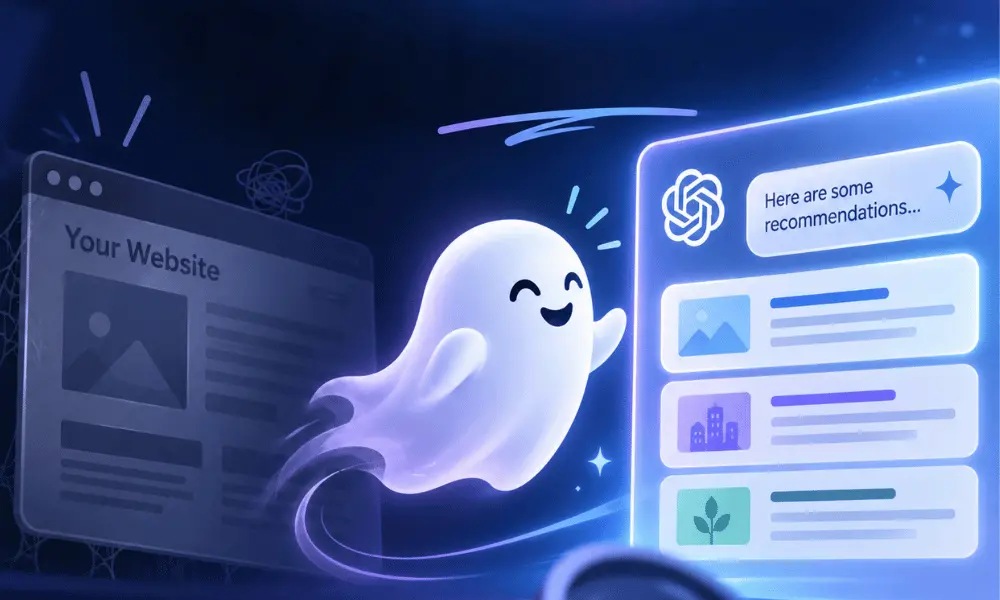
Your website says your company is experienced, trusted, and knowledgeable. But does anyone else on the web know you exist?
AI search systems encounter brands through searching third-party sources. These may include industry associations, trade publications, professional directories, review platforms, podcasts, partners, and local organizations.
If your brand only appears on pages you control, your digital presence can start to look a little ghostly.
How to Exorcise the Spirits and Build a Presence Beyond Your Website
Give reputable sources more reasons to mention your business.
Look for opportunities to:
- Earn industry mentions through expert commentary or useful resources
- Maintain trusted business profiles with accurate company information
- Join relevant professional associations and industry organizations
- Build partnerships that naturally generate references and mentions
- Earn customer reviews on established platforms
- Participate in industry and local communities where your expertise adds value
You do not need to haunt every corner of the internet. A strong AI search optimization strategy will focus on building relevant, credible mentions that help customers and AI systems recognize your business as offering legitimate, reputable services beyond your own domain.
7. Is Your AI Search Tracking Running on a Skeleton Crew?

Traditional rankings, organic traffic, and leads may still look healthy, but those numbers do not tell you the full story of how your brand appears in AI search. Google continues expanding Search Console reporting for its generative AI features, including newer visibility data for AI-driven and multimodal search experiences.
If you are not tracking AI visibility separately, your reporting may be missing a few important bones that make up the full picture of your search performance.
How to Put the Missing Bones Back Into Your AI Search Reporting
Track the questions real customers ask, and look for patterns across AI platforms.
Monitor:
- Whether your brand appears
- Whether your website is cited
- Which competitors surface
- Which pages are referenced
- Which third-party sources appear repeatedly
- How results change over time
Do not react to one isolated search as AI-generated answers vary by platform, prompt, and timing. The goal is to build a fuller picture of your visibility so your AI search strategy is not running on bare bones.
AI Search Engine Optimization FAQs
The best way to check AI search visibility is to test the same questions your customers are likely asking on Google AI Overviews, ChatGPT, Perplexity, Gemini, Claude, and other platforms. See whether your brand shows up, which pages get cited, and which competitors appear again and again.
One odd result does not tell you much. Skip the mad-scientist approach and look for patterns over time instead. If you need help turning those patterns into a plan, TheeDigital’s web design and digital marketing team can help strengthen your site, content, and search strategy that lurks behind your AI visibility.
No. AI SEO builds on many of the same foundations as traditional SEO, including crawlability, useful content, authority, internal linking, and a strong website.
Think of the two less like competing monsters and more like parts of the same Frankenstein creation: different pieces working together to improve how people find your business online.
TheeDigital’s AI search optimization work includes technical SEO, answer-focused content, entity clarity, third-party authority, prompt tracking, and traditional SEO improvements.
There is no Great Pumpkin that magically guarantees an AI citation. With countless businesses competing for attention, the goal is to give AI systems stronger reasons to find, understand, and reference yours. Our digital marketing strategists will identify where your visibility is falling short, strengthen the signals that matter, and keep testing what is actually helping your brand show up more often.
Yes. TheeDigital works with businesses that need visibility in one market, across multiple locations, or nationwide. Local AI search optimization can strengthen location-specific content, business information, service-area relevance, and broader authority signals.
The goal is to keep your digital presence from getting lost in the fog and give customers a clearer path to your business wherever they are searching.
You can handle some AI SEO tasks yourself, but technical fixes, content strategy, website UX, analytics, and ongoing optimization often require different skill sets.
TheeDigital has helped more than 1,000 businesses since 2004 and combines award-winning web design with digital marketing expertise. Rather than losing your head trying to manage every piece yourself, our experienced team can connect your website, search strategy, and lead-generation goals.
To learn more about the industries we serve and the results we have helped clients achieve, view our project portfolio and see how TheeDigital combines web design, SEO, and digital marketing strategy to support long-term growth.
Skip the Hocus Pocus and Build a Smarter AI Search Strategy
AI search visibility is not about tricks, shortcuts, or chasing every new platform update. It takes a strong website, useful content, technical SEO, and a digital marketing strategy built around how real customers conduct online searches. At TheeDigital, we combine web design, digital marketing, and AI search optimization expertise to help businesses improve visibility across traditional and generative AI search.
Need Help Navigating These Bad Omens?
If your website is showing a few bad omens, contact us today to breathe new life into your search strategy by calling 919-341-8901 or filling out our contact form to get started.
Tags: Digital Marketing • Search Engine Optimization
Shyanna Kelley
Shyanna collaborates with sales on lead generation efforts and planning and developing compelling digital assets for TheeDigital.